

Every AI answer arrives with a confidence it did not earn. A large language model does not know what is true; it predicts what is plausible, one token at a time. So where does the trust come from when a user reads a chatbot answer and believes it? New research published on 27 July by the Association of Online Publishers (AOP), based on an Ipsos survey of 1,000 UK adults, puts a number on it: the trust comes from the publisher brand cited underneath the answer. Trust the source, and you trust the answer. Distrust the source, and the same sentence collapses. For anyone thinking about the supply side of AI advertising, that is close to the whole argument in a single chart.
What did the AOP study actually measure?
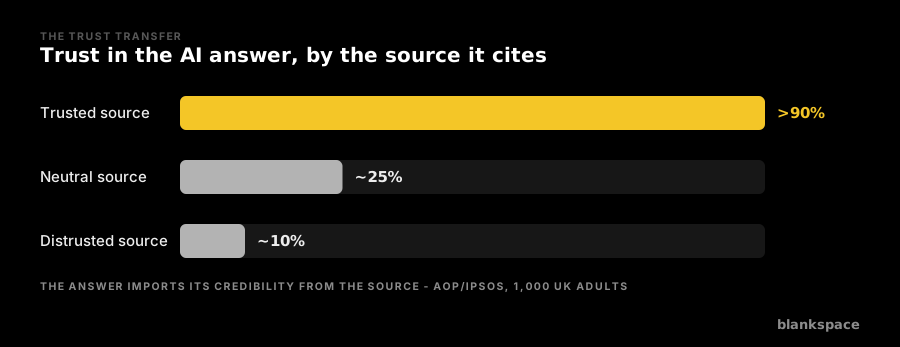
The study is the third release from AOP's ongoing "Artificial Intelligence Publisher Impact Study", written up by AOP managing director Richard Reeves. It asked a nationally representative UK sample how far they trusted an AI answer depending on which source was cited inside it. The relationship is almost linear. A completely trusted source produces more than 90% trust in the AI answer. A completely distrusted source drops that to around 10%. A neutral source, one people neither trust nor distrust, still only reaches about 25%. Read that middle number twice, because it is the one that matters for the business. Neutral is not good enough. An AI answer does not generate its own authority; it has to import authority from a named publisher, and premium newsbrands are the importers.
Why does the cited brand decide whether an answer is believed?
Because the model has no internal sense of truth, the citation is doing work the text cannot. A definition helps here. The value exchange between AI platforms and publishers is the trade in which platforms take publisher content as training data and real-time grounding, and publishers receive, in return, some mix of referral traffic, licensing fees and citations. The AOP finding sharpens what publishers are actually supplying on their side of that trade. It is not only the raw words that train the model. It is the brand itself, functioning as a credibility signal that "rubs off" (Reeves's phrase) on the interface displaying it. A trusted masthead next to an answer is worth more than the answer, because it is what converts a probabilistic guess into something a reader will act on.
There is a second-order effect that cuts against the platforms' interests. High trust also raises "stop here" behaviour, where a user reads the AI answer and does not click through at all. Reported willingness to stop was highest among users who completely distrust the sources (35%) and, revealingly, among those who completely trust them (32%). In other words, the more credible the cited publisher, the more comfortable the reader is never visiting that publisher. The brand does the persuading; the platform keeps the session.
What is the longer arc this sits inside?
This is not a standalone survey; it is the third panel of a picture AOP has been assembling all year. The first article in the series reported that AI answers are "good enough" for most users despite low clickthrough to sources. The second forecast that Google search traffic to leading UK publishers could halve by the third quarter of 2027. Set against the wider backdrop, the direction is consistent: automated traffic crossed 50% of all web requests in June 2026 on Cloudflare's measurement, machines now read the web more than people do, and yet the economics still assume a human clicking a link. Regulators have started to notice. The UK Competition and Markets Authority ruled in June that Google must let publishers opt out of AI Overviews, a rare lever in an ecosystem where publishers have had almost none. And platforms including OpenAI keep signing licensing deals with premium publishers, which is the clearest possible admission that they need an "anchor of truth" they cannot generate themselves.
What does this mean for publishers?
The read is the asset now, not the referral. If a trusted brand lifts an AI answer from 25% to more than 90% believability, then the citation is a paid placement whether or not anyone is paying for it today. The strategic error is to keep pricing the relationship on referral clicks, a number that is falling and, per AOP's own forecast, will keep falling. The opportunity is to price the grounding: the licensing, the citation, the trust transfer that makes the platform usable. One caution worth flagging: AOP is a publisher trade body, so these figures come from an interested named party and describe the UK market. The mechanism, though, is not controversial, and it points publishers toward collective pricing rather than the private, undisclosed licensing deals that Reeves warns amount to a "divide and conquer" strategy.
What does this mean for advertisers and brands?
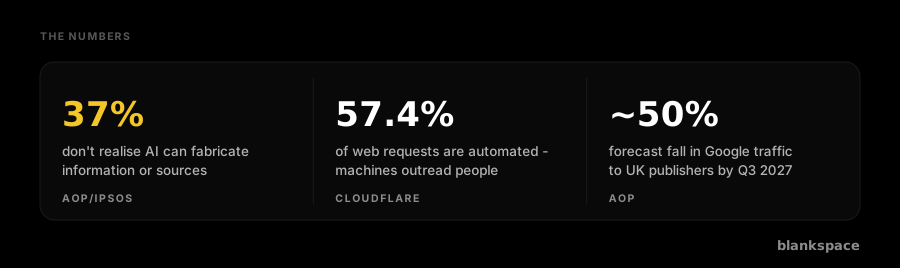
This is where Generative Engine Optimisation (GEO), the practice of making a brand visible and favourably cited inside AI answers the way SEO once targeted the ten blue links, stops being a buzzword. The study shows that citation is not cosmetic; it is the load-bearing element of whether an answer is believed. A brand that becomes a trusted cited source inside AI answers is not just visible, it is borrowing the same credibility multiplier the platforms borrow from publishers. And because trusted sources also earn nearly half of all clickthroughs from users who trust them, presence in the answer is both a branding surface and a demand channel. The corollary is a warning: 37% of respondents did not realise AI tools can fabricate information or sources at all, rising to around 45% of 45 to 54 year olds. Brands that let their name be attached to a hallucinated claim are exposed to an audience that will not know to doubt it.
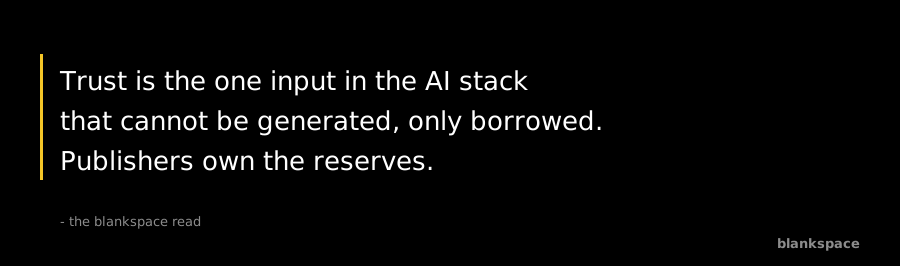
the blankspace read The platforms have quietly conceded the argument. You do not sign licensing deals for a commodity you can synthesise. The AOP numbers just price the concession: trust is the one input in the AI stack that cannot be generated, only borrowed, and publishers own the reserves. The mistake on the supply side is to keep invoicing for clicks while giving away the grounding for free. Monetise the read, meter the trust, and stop negotiating one masthead at a time.
Key figures
| Figure | Value | Provenance |
|---|---|---|
| Ipsos sample size, UK adults, nationally representative | 1,000 | named-party figure (AOP "AI Publisher Impact Study", Ipsos) |
| Trust in AI answer when source is completely trusted | more than 90% | named-party figure (AOP/Ipsos) |
| Trust in AI answer when source is completely distrusted | around 10% | named-party figure (AOP/Ipsos) |
| Trust in AI answer when source is neutral | around 25% | named-party figure (AOP/Ipsos) |
| Users unaware AI can fabricate information or sources | 37% (about 45% of 45 to 54 year olds) | named-party figure (AOP/Ipsos) |
| Trusting users who click at least one link in the answer | almost half | named-party figure (AOP/Ipsos) |
| "Stop here" behaviour, completely distrust vs completely trust | 35% vs 32% | named-party figure (AOP/Ipsos) |
| Forecast fall in Google search traffic to leading UK publishers by Q3 2027 | up to half | named-party figure (AOP, prior study in series) |
| CMA ruling requiring Google to let publishers opt out of AI Overviews | June 2026 | reported (Press Gazette) |
| Automated share of web requests when machines passed humans | 57.4% | reported (Cloudflare, June 2026, context) |
Primary source, opened and verified: https://pressgazette.co.uk/comment-analysis/new-research-reveals-ai-answers-only-as-trusted-as-the-newsbrands-they-cite/