

Ask what an AI company is actually buying when it signs a publisher and the answer is rarely the words themselves. It is legal certainty, a recognisable corpus, and one negotiation instead of ten thousand. That is why the money lands where it does. Licensing works, and it works well, for publishers who can supply all three. If your archive is not distinctive enough to be worth naming in a press release, and not large enough to be worth a lawyer's time, the deal does not shrink for you - it simply never gets offered. The useful question for most publishers in 2026 is therefore not how to negotiate a better licence. It is what to do about AI traffic that no licence will ever cover.
How much do AI licensing deals actually pay?
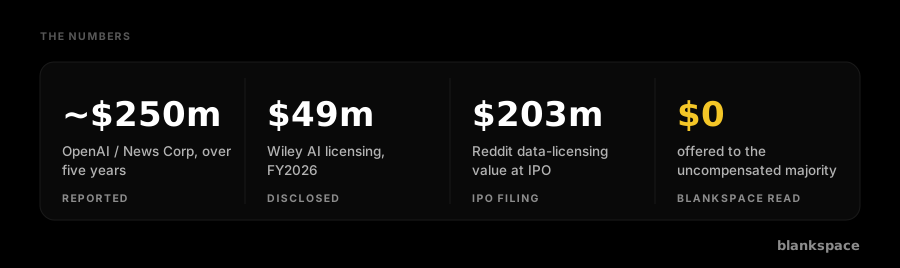
The top of the market is now well documented, and the numbers are large.
OpenAI's biggest disclosed agreement is with News Corp, reported at around $250m over five years, covering The Wall Street Journal, Barron's, The Times of London and The Australian. News Corp signed again with Meta in March 2026, in a deal reported at up to $50m a year over three years, and across its portfolio the company is reported to earn roughly $50m annually from AI licensing. Amazon's first AI licensing agreement, with The New York Times, is reported at $20m to $25m a year.
Outside news, academic and forum content has priced strongly. Wiley disclosed $49m of AI licensing revenue in its 2026 financial year, taking its lifetime AI revenue past $110m across several separate agreements. Reddit reported $203m in aggregate data-licensing contract value in its IPO filing.
Two caveats matter more than the headline figures. Most deal values are never disclosed, so any running total understates real spend. And these are the outliers by definition, which is precisely why they are reported at all.
Why most publishers are never offered a deal
Bilateral licensing is a procurement decision, and procurement favours concentration. An AI company weighing whether to negotiate with a mid-sized regional title is comparing that effort against signing one agreement that covers a hundred recognised mastheads. The small publisher does not lose the negotiation. It never enters one.
The result is a three-tier market. A first tier of large bilateral deals between major AI companies and major publishers. A second tier of marketplaces, collectives and intermediaries now assembling the middle. And an uncompensated majority sitting outside any agreement at all, which is where the overwhelming bulk of the web sits by page count.
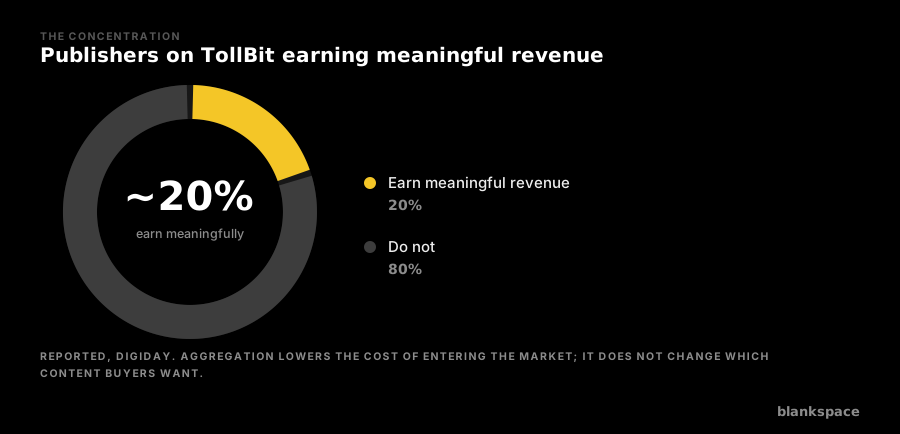
The evidence from the intermediary layer is sobering on this point. Digiday has reported that only around 20% of TollBit's publishers earn meaningful revenue through it, because even an automated access model concentrates payment on unique, high-value content. Nieman Lab's 2026 prediction round put it flatly: most publishers will see no meaningful AI licensing revenue. Aggregation lowers the cost of entering the market. It does not change which content buyers want.
What changed in 2026: from bilateral deals to marketplaces and collectives
The structural news of the past year is that licensing stopped being purely a negotiation and started becoming infrastructure.
Microsoft's Publisher Content Marketplace debuted in February 2026. Publishers set terms up front, usage is metered, and payment is tied to reported use when Copilot or another buyer grounds an answer in an article. Early partners include the Associated Press, Vox Media, USA TODAY, Condé Nast, Business Insider and Hearst's People Inc, with Yahoo joining as an early demand partner. The significant design choice is per-use reporting rather than a bulk flat fee, which is the first serious attempt to make licensing revenue vary with actual value delivered.
The RSL Collective, launched on 10 September 2025 by RSS co-creator Eckart Walther and former Ask.com chief executive Doug Leeds, takes the other route. It applies the ASCAP and BMI model to the web: publishers express licensing terms in robots.txt, and the collective negotiates on their behalf at scale, keeping a percentage of revenue that flows through rather than operating for profit. Arena Group, BuzzFeed, USA Today Co and Vox Media have joined a partner list now past fifty organisations. RSL has publicly described AI-use compensation for news as a $100bn opportunity for publishers, which should be read as the organisation's own framing of the prize rather than an observed market size.
Both models are aimed squarely at the second tier. Neither has yet produced public evidence that a typical small publisher receives a payment worth the administration.
The litigation track, and what the Anthropic settlement priced
The other thing that moved in 2026 was the legal floor under all of this. A federal court granted final approval in July 2026 to Anthropic's $1.5bn settlement with authors over books used in training, the largest known copyright class settlement, working out at roughly $3,000 per work across approximately 500,000 works.
That number is a genuine price signal, and the first one set by a court rather than a negotiation. It is also not a publisher revenue line. It is a one-off remedy for past conduct, concentrated on books, and it settles nothing about the dozens of cases still pending against OpenAI, Google, Microsoft, Meta and others. The practical read for publishers is that litigation raises the industry's willingness to pay for licensed data in general, which strengthens the first tier's leverage. It does not put recurring money in the accounts of anyone who was not already going to get a deal.
Licensing is incremental revenue, not a replacement
Even for publishers who do get paid, the honest framing from the sell side has hardened. Meta's December 2025 deals began producing meaningful revenue for some publishers for the first time during 2026, and USA Today Co reported notable AI licensing revenue in its Q1 2026 results. Those are real lines in real accounts.
They are also small against what is being lost. Trade reporting through 2026 has been consistent that licensing is an incremental revenue line rather than a lifeline, and that it does not offset the compounding referral traffic decline. Digiday's scorecard of the platforms, based on publisher ratings, summarised the mood as all of them could be doing more, no one gets a great grade. Microsoft scored best at 8 out of 10 on the strength of its messaging that publishers deserve to be paid for the quality of their IP. Anthropic scored zero for declining to engage on licensing at all. A market where the best-rated buyer scores 8 and the majority of sellers have no seat at the table is not a functioning content economy yet.
What a licence does not cover
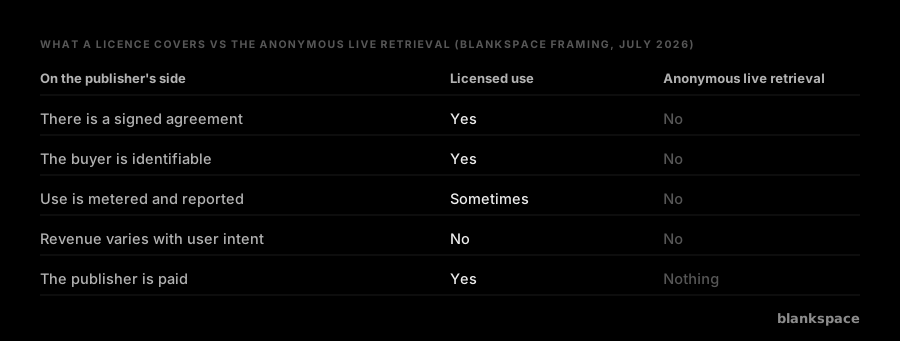
There is a category of AI traffic that sits outside almost every licensing structure in the market: the live retrieval.
When someone asks ChatGPT, Perplexity, Claude or Gemini a question that needs current information, the assistant dispatches an agent to fetch specific pages in real time. These Live Search Agents are the fastest-growing category of AI traffic and the closest to a purchase decision, because the user is actively researching something at the moment the fetch happens. A flat annual licence does not vary with that intent. Metered marketplace licensing gets closer, but only for the buyers inside the marketplace, and only where the fetch is attributable to a signed demand partner. The anonymous retrieval by an agent with no agreement in place - which is most of them - pays nothing under any licensing model.
The alternative for the uncompensated majority
For publishers who will never sign a bilateral deal, the practical route to AI revenue is to monetise the read itself rather than the rights around it. Because Live Search Agents parse text and skip JavaScript, that monetisation has to live in the content layer rather than in the display ad stack.
blankspace operates here. When a Live Search Agent retrieves an eligible page, blankspace runs a real-time auction at the CDN edge and inserts a relevant, accurate brand fact into the content as editorial context, then attributes the revenue the same day. It requires no negotiation with an AI company, does not depend on being large enough to be noticed, and scales to publishers of any size. blankspace reports a $15 CPM on this inventory from its own accounts, which is its own figure rather than an industry benchmark.
How to decide whether to pursue licensing
If you have a recognised brand, a distinctive archive and clean rights, a licensing conversation is worth having, and it can sit alongside other monetisation rather than replacing it. Register with a marketplace or collective if the terms are non-exclusive, since the cost of listing is low and the second tier is where the next tranche of demand is being assembled.
If you are everyone else, plan on the assumption that no offer is coming and build around the traffic you can monetise without one. In both cases the first step is identical: get visibility into your AI traffic and split it into training crawls, which a licence might cover, and live retrievals, which it will not. You cannot price what you cannot see, and most publishers still cannot see it.
Frequently asked questions
How much do AI content licensing deals pay?
The largest reported agreements run to tens of millions a year for individual major publishers. News Corp is reported at around $250m over five years with OpenAI and up to $50m a year with Meta, Amazon's deal with The New York Times at $20m to $25m a year, and Wiley disclosed $49m in its 2026 financial year. The typical publisher is offered nothing.
Can a small or independent publisher get an AI licensing deal?
Almost never on a bilateral basis. Collectives such as RSL and metered marketplaces such as Microsoft's Publisher Content Marketplace exist to aggregate smaller publishers, and joining a non-exclusive one costs little. But Digiday has reported that only around 20% of publishers on TollBit earn meaningful revenue, which is a fair guide to how concentrated payouts remain even after aggregation.
What is the difference between a licensing deal and a content marketplace?
A bilateral licence is a negotiated agreement, usually a flat or annual fee, between one publisher and one AI company. A marketplace such as Microsoft's PCM standardises the terms, meters actual usage, and pays against reported use across multiple buyers. The marketplace lowers the barrier to entry and ties revenue to value delivered, but it does not create demand for content buyers do not want.
Does the Anthropic copyright settlement mean publishers will get paid?
Not directly. The $1.5bn settlement approved in July 2026 covers authors of roughly 500,000 books at around $3,000 per work, and it is a remedy for past training conduct rather than an ongoing publisher revenue stream. Its wider effect is to raise the cost of unlicensed training data across the industry, which strengthens the bargaining position of publishers already large enough to negotiate.
If licensing will not pay me, what will?
Content-layer advertising monetises the retrievals themselves rather than the rights around them. It requires no agreement with an AI company, works for publishers of any size, and captures the live retrieval traffic that licensing structures leave uncompensated. That is why it is the realistic option for the majority the licensing market excludes.