

For most of the web's history, ranking first and being trusted were the same achievement. That is no longer true. An AI assistant reading the web to compose an answer does not simply reach for Google's top result; it weighs sources on its own terms, and increasingly names pages that never ranked highly while skipping pages that do. SEO is the discipline of earning the rank and the click that follows. GEO, generative engine optimisation, is the discipline of earning the citation inside a generated answer, where there is often no click to be had. The two share foundations, but in 2026 they pull in visibly different directions.
The core distinction
SEO was built for a web of links. The user types a query, the engine returns a ranked list, and the user clicks through to a page where the publisher monetises the visit. Success is a high rank and the click that follows. GEO is built for a web of answers. The user asks a question, the assistant composes a response from the content it has read, and names or cites the sources it trusts. Success is being in that answer, frequently with no click at all.
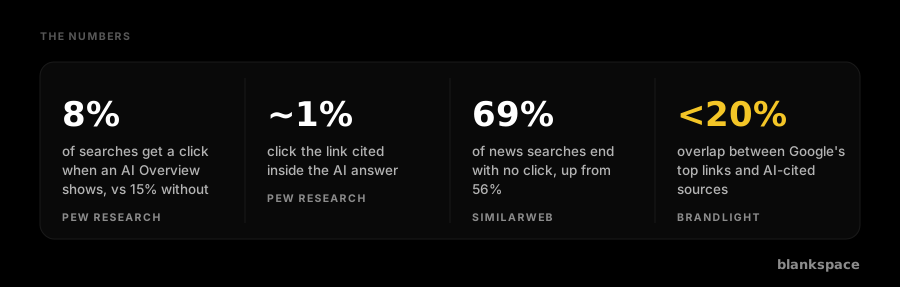
The scale of the no-click outcome is now measurable. A Pew Research Center study of 68,000 searches found that users clicked a result on just 8% of searches where an AI Overview was present, against 15% where it was not, and clicked the link cited inside the AI Overview only about 1% of the time. Similarweb reported that the share of news-related Google searches ending without any click rose from 56% in May 2024 to 69% in May 2025. GEO is the response to a world where the answer, not the link, is the destination.
Where GEO and SEO overlap
The two are not opposed, and good practice in one usually helps the other. Authoritative, accurate, well-structured content is rewarded by both search engines and AI systems, because generative engines lean on many of the same authority and relevance signals that search algorithms use. Clear headings, fast pages, sound technical foundations, and credible authorship matter either way. A site that has done SEO well has a head start on GEO, because much of what makes a page rankable also makes it citable. The mistake is to assume that is the whole story, because GEO adds requirements that classic SEO never had.
Where they differ in practice
The clearest sign that GEO and SEO have separated is that the same query no longer produces the same winners. Analysis from the GEO firm Brandlight found that the overlap between the top links on a Google results page and the sources cited in AI answers has fallen from around 70% to below 20%, and the gap is still widening as each assistant develops its own preferences. Ranking first is no longer a reliable route to being cited.
Beyond that, the differences are in emphasis and method. SEO optimises around keywords and ranking signals such as backlinks and on-page relevance. GEO optimises around language, entities, and extractability, because the consumer of the content is a model assembling an answer, not only a person scanning links. SEO wants the click; GEO often accepts there is no click and aims instead for the brand or content to be present in the answer, which keeps you visible even in a zero-click result.
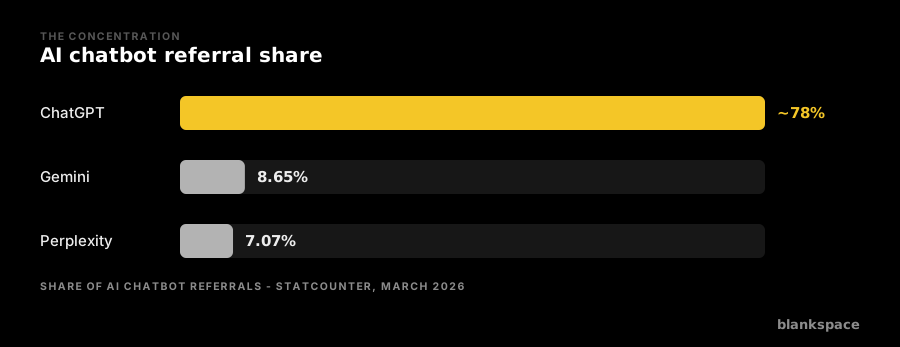
The audiences also fragment differently. SEO targets one dominant search ecosystem. GEO has to account for several assistants that cite different sources in different ways, so the same page can perform very differently across ChatGPT, Gemini, and Perplexity. That field is both large and unstable: ChatGPT alone processes roughly 2.5 billion prompts a day, and StatCounter's March 2026 data put ChatGPT at about 78% of AI chatbot referrals, with Gemini overtaking Perplexity for second place at 8.65% against 7.07%. Optimising for a single engine is no longer enough.
What GEO asks for that SEO does not
The term GEO comes from a 2023 research paper, "Generative Engine Optimization", led by researchers at Princeton, which found that source-side tactics such as adding citations, quotations, and statistics could raise a page's visibility in generative engine responses by up to 40%. Later analyses have put numbers on the individual moves: adding relevant statistics lifted visibility by around 41%, with citing sources and adding quotations landing in a similar 30 to 41% range.
Three further habits carry more weight for GEO than for SEO. Freshness is one: recently updated content is cited roughly 4.3 times more often, and around 85% of AI Overview citations point to material less than two years old, so a page dated 2023 is quietly discarded as stale. Earned authority is another: brand mentions across the web correlate with AI citation far more strongly than backlinks do, roughly 0.66 against 0.22, and about 84% of AI citations trace back to earned media rather than paid or advertorial placement. Tone is the third: promotional, salesy copy is negatively correlated with being cited, so the marketing register that once helped a landing page now works against it.
In practice, that means leading each page with a direct, self-contained answer a model can lift, using question-format headings that match how people ask, supporting claims with specific figures and named sources, adding structured data so machines read the meaning, keeping brand and product entities consistent across the web, and updating content so it stays current. These are GEO-specific layers on top of solid SEO, not replacements for it.
How GEO and SEO are measured
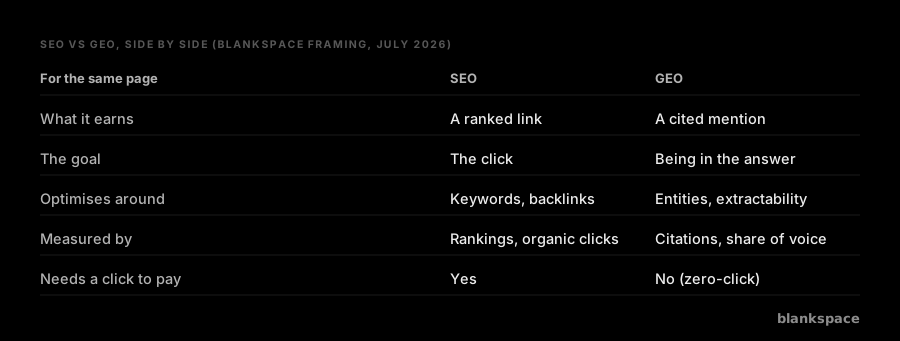
The metrics diverge because the outcomes do. SEO is measured by rankings, impressions, and organic clicks, all of which assume a visit. GEO is measured by presence in the answer: how often your brand or content is mentioned, how often it is cited as a source, your share of voice against competitors, and the sentiment of those mentions, tracked separately for each assistant because results rarely match across them. A growing set of AI-visibility tools exists to measure exactly this, which is itself a sign that GEO has become a discipline with its own scoreboard rather than a footnote to SEO reporting.
GEO, SEO, and earning from AI traffic
For publishers there is a third dimension neither term fully covers: revenue. SEO monetises the human click. GEO improves whether AI systems cite you. But when a live search agent reads your page to build an answer, that read earns nothing through traditional means, because the agent runs no JavaScript and triggers no ad call. blankspace addresses that gap, monetising live search retrievals at the CDN edge where the read actually happens. The clean way to hold the three together is that SEO wins human visits, GEO wins AI citations, and content-layer monetisation earns revenue from the AI reads that GEO helps generate.
Frequently asked questions
Is GEO replacing SEO?
No. They coexist. SEO still governs traditional search visibility and the human clicks it produces, and generative engines still borrow its authority signals. As AI answers take more queries, GEO matters more, but the evidence in 2026 is that publishers need both rather than a switch from one to the other.
Can I do GEO without doing SEO?
In practice the two share foundations, so strong SEO makes GEO easier. You can emphasise GEO-specific habits such as direct answers, structured data, statistics, and entity clarity, but the underlying quality and authority that SEO rewards also help you get cited. The reverse is not reliable: ranking well no longer guarantees a citation, since the overlap between top Google links and AI-cited sources has fallen below 20%.
How is GEO measured compared with SEO?
SEO is measured by rankings, impressions, and organic clicks. GEO is measured by how often your brand or content is mentioned and cited in AI answers, your share of voice against competitors, and the sentiment of those mentions, tracked per assistant because ChatGPT, Gemini, and Perplexity cite different sources.
Does GEO help if AI answers do not send clicks?
Yes. The value of GEO is presence in the answer, which keeps your brand and information in front of the user even when there is no click, and Pew's data shows clicks are now the exception rather than the rule when an AI answer is present. For publishers, that presence can also be monetised at the content layer, so a read that sends no visit still need not be free.
Which matters more, GEO or SEO?
It depends on how your audience searches. The more they use AI assistants for the questions you want to win, the more GEO matters. Given that the sources AI tools cite now diverge sharply from the pages that rank, most publishers and brands need a strategy for both rather than a choice between them.