

The worth of AI bot traffic is decided at two moments that almost never meet: the instant a crawler reads a page, and the instant a person acts on the answer that read produced. Today most publishers capture neither. AI crawlers now account for the majority of automated requests on the web, yet they return a human referral for only a tiny fraction of what they take, so the recorded value of that traffic on nearly every site is zero. Its real value is set by the commercial intent behind each read, which is why a single decision-stage retrieval can be worth more than the pageview it quietly replaced.
Why most publishers still earn nothing from AI bot traffic
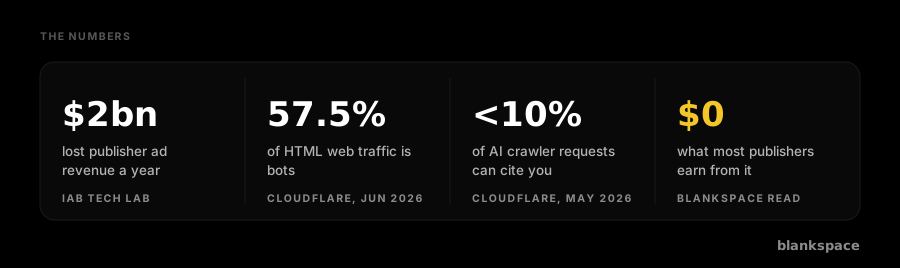
Start from the baseline. A Live Search Agent fetches a page, reads it, and leaves without running any JavaScript, so the ad auction never fires and no revenue is recorded. Multiply that by scale and the loss is large: the IAB Tech Lab estimates publishers are losing around $2 billion a year in advertising revenue to AI-driven search features that answer the question without sending the click, with traffic reductions of 20 to 60 per cent on average and as much as 90 per cent for some niche sites. For most publishers, then, the current value of AI bot traffic is exactly nothing, not because the traffic lacks value, but because the infrastructure to monetise a read at the content layer has not been in place.
How much are AI crawlers actually taking?
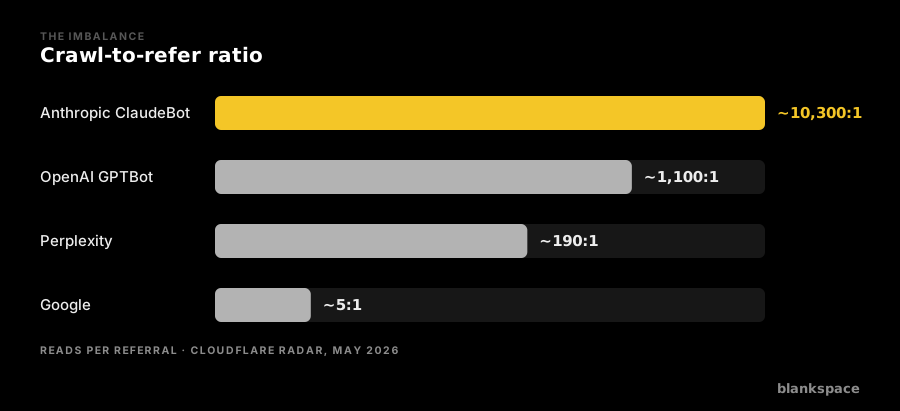
The imbalance is now measurable, and it is stark. Cloudflare reported that bots generated 57.5 per cent of HTML web traffic by June 2026, the first time automated requests have held the majority over humans. Almost none of that volume comes back as an audience. On Cloudflare Radar's May 2026 data, Anthropic's ClaudeBot crawled roughly 10,300 pages for every referral it sent, down from about 23,951 to one earlier in the year but still enormous; OpenAI's GPTBot sat in the region of 900 to 1,300 to one, and Perplexity's crawler around 190 to one. Google's traditional crawler, by contrast, was near 5 to one, a reminder of what a traffic-reciprocating relationship used to look like.
The mix compounds the problem. Cloudflare found that search-purpose crawling, the kind that can actually return a citation, was under 10 per cent of AI crawler requests in May 2026. The other 90 per cent is extraction for training or augmentation with little or no referral attached. TollBit's State of the Bots data tells the same story from the publisher side: across 2025 the ratio of AI bot visits to human visits tightened from roughly one in 200 to about one in 31, retrieval (RAG) bots made around ten page requests for every training-bot request, and one site logged 966 scrapes for every single referral. AI systems are reading more than ever and sending back less than ever, which is precisely why the volume is worth pricing rather than ignoring.
What determines the value of AI traffic
The worth of AI bot traffic comes down to commercial intent, and not all of it is equal.
Intent and funnel stage matter most. A retrieval against a product comparison or a buying guide, where a user is close to a decision, is worth far more than a retrieval against general informational content, because advertisers will pay to appear in the answer at that moment. Decision-stage segments command the highest CPMs.
Content category matters. Advertisers target by IAB content category, so a site with a clear category profile attracts more confident, higher bids than a general-interest site where advertisers cannot predict what their message will sit beside.
Content specificity and depth matter. A page comparing five named products earns more than a vague overview, and longer, comprehensive pages attract more retrievals per crawl cycle, generating more impressions.
The AI source matters. Different assistants have different commercial and referral profiles, so a site retrieved heavily by one assistant can see different auction dynamics than one retrieved mostly by another.
Why AI retrievals can be worth more than human visits
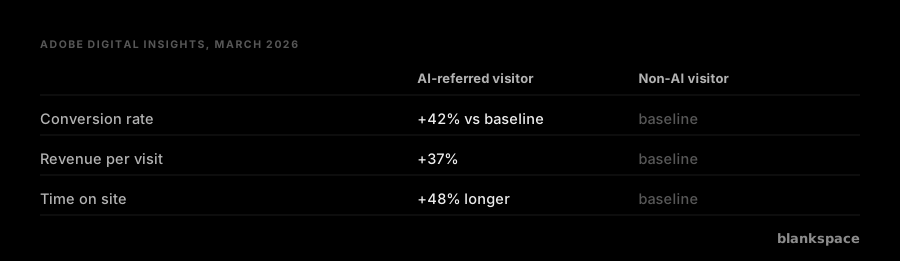
A human arriving from organic search may be anywhere in their journey. A Live Search Agent retrieval happens because a user just asked a question, often a buying question, and the answer is being assembled in front of them. The audience reached through AI is therefore unusually high in intent, and the conversion data has now caught up with the theory. Adobe Digital Insights found that in March 2026 visitors arriving from AI assistants such as ChatGPT and Perplexity converted 42 per cent better than non-AI traffic, generated 37 per cent more revenue per visit and spent 48 per cent longer on site, a reversal from a year earlier when the same channel converted worse than average. Channel-level figures point the same way, with reported conversion rates around 15.9 per cent for ChatGPT referrals and 10.5 per cent for Perplexity, well above typical organic search. blankspace sees the same pattern in its own accounts, where AI referral traffic converts at rates meaningfully above organic search. In other words, the agent reading your page is frequently a better-qualified audience than the human you used to monetise, arriving at the precise moment of purchase research.
Turning value into a number for your site
The practical way to value your own AI traffic is to measure before you monetise. Capture and classify AI agent traffic at the CDN edge, see the volume, the mix of Live Search versus training crawlers, and which pages are retrieved most. Cluster the retrievals into intent segments and funnel stages to see which of your content reaches decision-stage audiences. That gives you an estimated CPM per segment and a realistic picture of the inventory you are sitting on.
From there the monetisation route depends on the bot. Training crawlers that take content and return nothing are best handled through access charges: 2026 brought a wave of edge tooling for exactly this, including Cloudflare's pay-per-crawl and pay-per-use models and AWS WAF's AI traffic monetisation control, all of which meter and bill crawlers at the CDN or firewall. Live Search Agents that read a page to answer a live question are a different opportunity, because the value is in the answer, not the crawl. That is where blankspace monetises: a relevant brand fact is injected into the text the agent reads, server-side at the edge, with revenue attributed per eligible retrieval the same day. In live blankspace accounts the average has benchmarked around $15 per thousand, comparable to premium programmatic, with high-intent decision-stage retrievals worth considerably more. Metering the crawl and monetising the answer are complementary, and a publisher measuring first can decide which pages belong in which lane.
Frequently asked questions
What CPM can publishers expect from AI bot traffic?
In live blankspace accounts the average has benchmarked around $15 per thousand, comparable to premium programmatic. That is blankspace's own reported figure rather than an industry guarantee, and it varies with your content categories and intent mix. High-intent decision-stage segments can be worth significantly more, while general informational retrievals are worth less.
Why is AI bot traffic worth anything if they are just bots?
Because the bot is reading your content to answer a real person's question, usually at the moment that person is researching a decision. Adobe's 2026 data shows AI-referred visitors converting 42 per cent better and generating 37 per cent more revenue per visit than non-AI traffic. The value is in reaching that person's query, not in the bot itself.
Do all AI bots have the same value?
No. Live Search Agents answering live user questions are generally the most valuable because they are closest to intent and can carry a monetised answer. Training crawlers gathering bulk data return almost nothing on their own, with crawl-to-referral ratios running into the thousands to one, so they are monetised differently, through licensing or per-crawl access charges.
How much are AI crawlers taking compared with what they return?
A great deal, and the gap is widening. Bots passed 57 per cent of HTML web traffic in 2026, search-purpose crawling that can return a citation is under 10 per cent of AI crawler requests, and leading training crawlers read hundreds to over ten thousand pages for every referral they send. That imbalance is the reason unmonetised AI traffic is a growing cost rather than a neutral one.
How do I find out what my AI traffic is worth?
Measure it first. Classify your AI agent traffic at the edge, cluster retrievals into intent segments with estimated CPMs, and review which pages reach high-intent audiences before monetising. A free domain audit or edge analytics integration can produce this picture, after which you can charge training crawlers for access and monetise Live Search Agent reads in the answer itself.