

Reddit, USA Today and Reuters Are Weighing Whether to Block Google. The Real Question Is What They Get for the Read.
For twenty years the deal between Google and the open web was simple enough that nobody wrote it down. Publishers let Google's crawler take their content, Google sent readers back in return, and both sides called it fair. That deal is now being renegotiated in public. According to a Wall Street Journal report, Reddit, USA Today, Reuters, Politico, The Economist and People Inc. are all reconsidering how much access they should give Google as AI Overviews answer questions on the results page and the return traffic collapses. USA Today Co. CEO Mike Reed put the mood plainly: "It's time to take a stand and say enough is enough."
The headline is that publishers might block Google. The story that matters for anyone in this market is quieter and more structural: the web's biggest content owners have worked out that they are being read at full scale and paid almost nothing for the read, and they are running out of patience.
What did the Wall Street Journal actually report?
The WSJ reported that several of the largest publishers on the web are weighing whether to restrict Google's access to their content. Reddit is the sharpest case. It is negotiating a possible renewal of the licensing agreement it signed with Google in 2024, a deal reported to pay Reddit around $60 million a year for a constantly updated feed of human conversation. That felt like found money before an IPO. It feels different once the same scooped-up posts are used to answer questions inside Google without sending anyone back to Reddit. Investors noticed the tension: Reddit shares fell as much as 5.8% in premarket trading after the report.
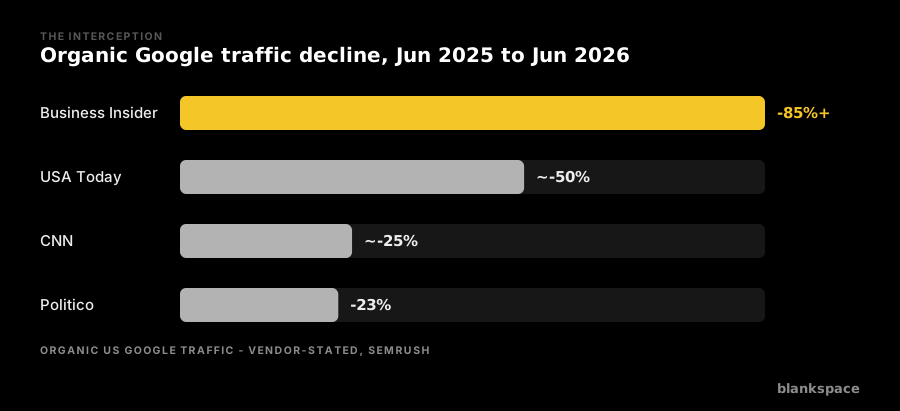
The traffic numbers explain the anger. Per Semrush data cited in the reporting, organic US Google traffic to the national USA Today site fell by almost half between June 2025 and June 2026. Politico was down 23%, CNN lost around 25%, and Business Insider's traffic fell more than 85%. These are not soft declines that a redesign fixes. They are the shape of an audience being intercepted upstream.
Why is this a pricing problem and not a traffic problem?
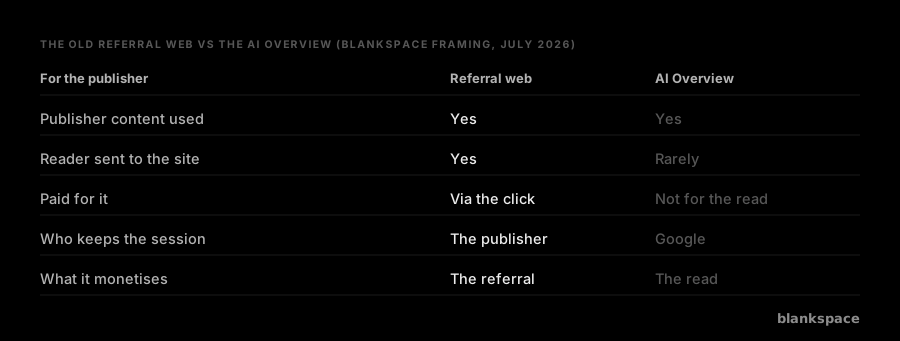
Because framing it as traffic assumes the old deal still applies and just needs topping up. It does not. Definition, because the whole argument turns on it: a referral is a click Google sends to a publisher's site; a read is Google's AI ingesting that publisher's content to compose an answer. The web was built to monetise the referral. AI Overviews monetise the read and hand the publisher back a shrinking sliver of the referral, if that.
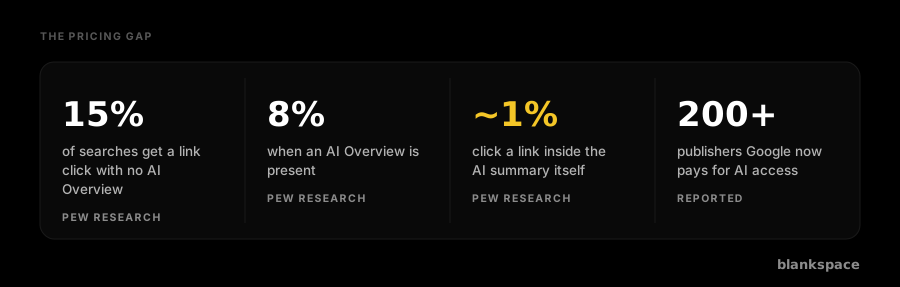
The Pew Research Center numbers make the gap concrete. Users clicked a traditional link in about 15% of searches without an AI Overview, falling to roughly 8% when an Overview appeared. Links inside the AI summary itself were clicked in only about 1% of searches. So the read happens every time and the referral happens almost never. Google's own controls do not resolve this. Publishers can block training via Google-Extended, but stopping their content from appearing in AI Overviews has been tied to the risk of losing visibility in ordinary search as well, which is why "just opt out" has never been a real option. That coupling is exactly what the UK's Competition and Markets Authority moved against last month when it ordered Google to let publishers opt out of AI search features without sacrificing their place in traditional results. Google says it will test the controls in Britain before deciding on a global rollout, with no timeline given.
What does this mean for publishers?
It means the leverage is real but the weapon is clumsy. Blocking Google entirely is the nuclear option; noindex removes pages from search altogether, and nosnippet degrades their presence. A publisher that blocks Google to protect the read also forfeits whatever referral is left. That is why the language is "weighing" and "reconsidering" rather than "blocking." The honest position for most publishers is that they want a price for the read, not an exit from Google.
The tell is that the market for the read already exists; it is just thin and selective. Google has started paying more than 200 publishers for AI access. Reddit's $60 million deal is a read licence in all but name. What the WSJ report describes is a cohort of large publishers deciding that the implied price of the read, often zero, is no longer acceptable, and using the only lever they hold (crawler access) to force a number onto the table. The ones with distinctive, hard-to-substitute content (Reddit's conversations, Reuters' wire, People's celebrity reporting) have the most credible threat, because Google's answers are worse without them.
What does this mean for advertisers and brands?
The lever publishers are reaching for is the same surface brands are trying to appear inside. If large publishers restrict or reprice access to AI answers, the pool of freely readable, citable content that models draw from gets smaller and more curated. Generative engine optimisation, GEO, the practice of getting a brand mentioned and cited inside AI generated answers, gets harder to game with volume and more dependent on being the kind of source a model, or a licensing team, actually values. A brand that has quietly relied on third-party publisher coverage to show up in AI answers should assume that supply is about to become contested and, in places, paywalled.
the blankspace read: Everyone is reporting this as publishers threatening to leave Google. Read it the other way. Six of the most powerful content owners on the web have just said, in unison and on the record, that the read has a price and it is not zero. That is the entire blankspace thesis arriving as a news event. The web is not fighting to keep the referral; the smart money is done defending clicks. It is fighting to get paid for the read, because the read is the thing AI actually consumes. Blocking is a negotiating posture. A per-read market is the destination, and the publishers with content Google cannot fake are the ones who will set the first prices.
Key figures
| Figure | Value | Provenance |
|---|---|---|
| Publishers reconsidering Google access | Reddit, USA Today, Reuters, Politico, The Economist, People Inc. | reported (WSJ) |
| Reddit-Google 2024 licensing deal | ~$60 million per year | reported |
| Reddit share move after report | fell as much as 5.8% premarket | reported |
| USA Today national site organic US Google traffic, Jun 2025 to Jun 2026 | down ~50% | vendor-stated (Semrush) |
| Politico / CNN / Business Insider traffic decline | -23% / ~-25% / -85%+ | vendor-stated (Semrush) |
| Link click rate without AI Overview | ~15% of searches | reported (Pew Research Center) |
| Link click rate with AI Overview present | ~8% of searches | reported (Pew Research Center) |
| Click rate on links inside the AI summary | ~1% of searches | reported (Pew Research Center) |
| Publishers Google now pays for AI access | 200+ | reported |
| USA Today Co. CEO on the situation | "It's time to take a stand and say enough is enough." | named-party figure (Mike Reed) |
Primary source, opened and verified: The reporting originates with a Wall Street Journal scoop (https://www.wsj.com/business/media/google-search-publishers-ai-content-0fb06e41). We opened and verified the corroborating account, including the Semrush and Pew figures and the Mike Reed quote, at TechSpot: https://www.techspot.com/news/113199-reddit-major-publishers-consider-blocking-google-ai-search.html