

Between the handful of newsrooms that sign multimillion-dollar agreements with AI companies and the large majority of publishers offered nothing sits a middle layer of platforms trying to price content at scale. That middle layer is the licensing marketplace: an intermediary that stands between publishers and AI developers so that a publisher lists its content and sets terms once, and the platform then handles matching, permissions, metering and payment across many AI buyers. In return the publisher takes a revenue share or a per-use fee without running a fresh negotiation for every model. The models diverge on fundamentals, and those differences decide how much you actually earn: some license text for model training, some meter access to live retrievals, and some pay a share of a search product's revenue based on how often your content is cited.
What is an AI content licensing marketplace?
An AI content licensing marketplace is a platform that aggregates many publishers on one side and many AI companies on the other, and standardises the commercial relationship between them. Instead of a publisher negotiating a bespoke contract with each AI developer - which in practice only the largest publishers are ever offered - the publisher onboards once, sets its terms and permissions, and the marketplace does the matching, rights administration, usage tracking and payment.
Analysts describe the licensing market in three tiers. At the top are a small number of large bilateral deals between major AI companies and major publishers. At the bottom is an uncompensated majority of publishers and creators sitting outside any deal. The marketplace is the emerging middle layer that is supposed to reach everyone the top tier leaves out. The "Same Gatekeepers, New Tollbooths" report published in April 2026 by the Open Markets Institute's Center for Journalism and Liberty, authored by Dr Courtney Radsch and Karina Montoya and drawing on more than 35 interviews with publishers and licensing startups, is the first comprehensive map of exactly this market.
Why the marketplaces exist
Marketplaces exist because the deal most publishers read about is not the deal most publishers will ever be offered. Bilateral agreements are negotiated one at a time and favour large, recognised content libraries, so an AI company has little incentive to sit down with a small site when it can sign one contract covering a major publisher instead. That leaves the long tail with content that is being read and used but not paid for.
The catch is who controls the terms. The Center for Journalism and Liberty report frames the market as a "double bind": the same big technology companies whose AI products are stripping publishers of search traffic are also the ones building and pricing the alternative revenue that is meant to replace it, occupying both sides of the value chain at once. The report also warns of "sloppification", a slow degradation of AI's own outputs as the supply of quality human-created content dries up, which is the long-run argument for paying sources properly. Marketplaces are the industry's attempt to give the excluded majority a route in - though, as the report stresses, a route in is not the same as fair value.
How the main AI content licensing marketplaces work
The marketplaces are not one model. They split into three broad approaches, and the approach matters more than the brand name, because it determines what you are actually selling.
Revenue share on an AI search product
Some marketplaces run their own AI answer engine and pay publishers a share of the money it makes. ProRata.ai is the clearest example. Its consumer product, Gist Answers, launched in September 2025 alongside a reported 40 million US dollar Series B, and answers questions using only licensed content from publisher partners. Publishers receive a reported 50/50 split of the subscription and advertising revenue the product generates, allocated proportionally by a patent-pending attribution system that scores how much each source contributed to a given answer. ProRata has reported partnerships spanning several hundred publications, including names such as The Boston Globe, Future and Vox Media. The appeal is that it puts a price on the citation itself; the limitation is that the pool is only as large as the product's own revenue.
Training-rights marketplaces
Other platforms broker the right to use content to train models, rather than to answer live queries. Created by Humans operates this way, initially for books and authors: a rightsholder claims a work (by ISBN or direct upload), verifies identity, sets restrictions on how the text may be used - for example limiting verbatim reproduction or summary use - and the platform then negotiates licences with AI developers on those terms, with plans to expand into video, music and other media. Human Native, a UK-based marketplace, similarly matches rightsholders with AI developers and administers the licences. These platforms suit publishers and creators whose value to an AI company is the corpus itself, and they are built to replace copyright litigation with a standardised, permissioned transaction.
Access-metering marketplaces
A third group charges AI companies for access at the point of the read and passes the money back to the publisher. TollBit is the best-known: publishers set per-fetch rates, TollBit meters crawler and agent requests and bills the AI company, and the publisher keeps the resulting revenue while TollBit takes its margin from the AI side rather than from the publisher's share. Sphere works on a similar principle of letting publishers retain effectively all of their content revenue while the fee falls on the AI company. ScalePost sits alongside these as a content marketplace and analytics layer, and is reported to take roughly a 15 per cent cut of the revenue earned by rightsholders. These are closest to a metered utility for AI access, and they overlap with pay-per-crawl tooling rather than with training licences.
What they charge and who pays
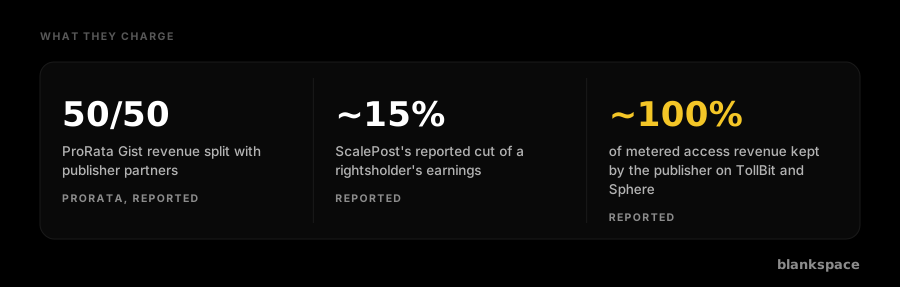
The economics vary enough to change the decision. ProRata's reported 50/50 split is generous per unit but is drawn only from its own search product's revenue. ScalePost is reported to take about 15 per cent of the rightsholder's earnings. TollBit and Sphere are structured so the publisher keeps close to all of the headline revenue, with the platform's fee charged to the AI company instead. Training-rights platforms such as Created by Humans and Human Native take a negotiated cut of each licence they broker. None of these is a like-for-like comparison, because a 50 per cent share of a small answer-engine pool and a 100 per cent share of metered access fees are prices on entirely different things. The right question is not who takes the smallest cut, but which activity - training, live retrieval, or citation in an answer - actually describes how AI companies use your content, and whether the platform is paid by a party with a real incentive to pay.
What a licensing marketplace does not monetise
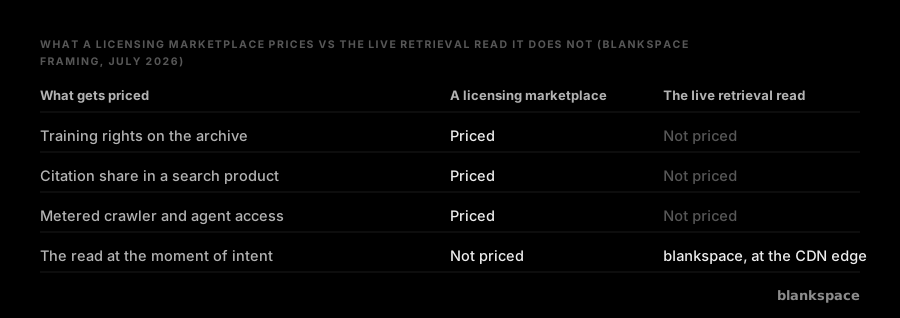
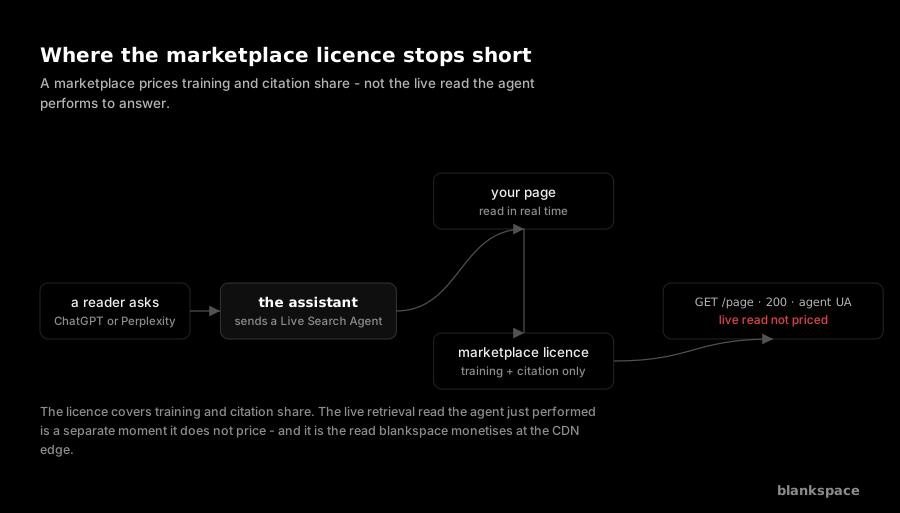
Every marketplace above prices either the corpus (training rights) or the output (a share of a search product, or a metered access fee). What none of them prices well is the individual live read at the moment of intent. When a reader asks ChatGPT, Perplexity, Claude or Gemini a question, the assistant frequently dispatches a Live Search Agent to fetch a specific page in real time so it can answer. That retrieval is the fastest-growing category of AI traffic and the closest to a buying decision, because the user is actively researching when the agent reads the page. A training licence does not vary with it, and a revenue-share pool only pays out if the AI company has chosen to join that particular marketplace.
This is the layer blankspace works in, and it is complementary to a marketplace rather than a substitute for it. Because Live Search Agents parse text and skip the JavaScript layer that display ads rely on, monetisation has to live in the content itself. When an eligible page is retrieved, blankspace runs a real-time auction at the CDN edge and inserts a relevant, accurate brand fact into the content as editorial context, then attributes the revenue the same day. It does not require the AI company to have signed up to anything, and it scales to any publisher regardless of size. A publisher can list on a licensing marketplace to sell training rights or citation share, and separately monetise the live retrieval read at the edge, because the two address different moments in how AI uses the page.
Should you list your content on one?
For most publishers, a marketplace is worth trying precisely because the alternative - a bilateral deal - is not on offer. The practical steps are to work out which type fits your content, read the terms with care, and avoid treating any single platform as your whole AI strategy. If your value is a large, distinctive archive that AI companies want to train on, a training-rights marketplace is the natural route. If you are read constantly in live answers, an access-metering platform or edge-level monetisation of the read matters more than a training licence. If you want to be paid for citations in a search product, a revenue-share marketplace is the only model that attempts it. In every case the first move is the same as it is for licensing generally: get visibility into your AI traffic, so you know how much of it is training crawlers that a licence might cover, and how much is live retrieval that it will not.
Frequently asked questions
What is the difference between an AI licensing marketplace and a bilateral licensing deal?
A bilateral deal is a single contract negotiated directly between one AI company and one publisher, usually a large one, granting broad usage rights for a flat fee, per-use rate or revenue share. A marketplace is an intermediary platform that lets many publishers license to many AI companies on standardised terms, onboarding once instead of negotiating each deal. Bilateral deals reach the largest publishers; marketplaces are built to reach the long tail those deals ignore.
How much do AI content licensing marketplaces pay publishers?
It depends entirely on the model and is rarely disclosed in aggregate. ProRata reports a 50/50 split of its Gist Answers revenue, allocated by attribution. ScalePost is reported to take about 15 per cent of a rightsholder's earnings, leaving the rest to the publisher. TollBit and Sphere are structured so the publisher keeps close to all of the metered access revenue, with the fee charged to the AI company. Absolute payouts still hinge on how much AI usage and revenue actually flows through each platform, which for most publishers remains modest.
Which AI content licensing marketplace should a small publisher use?
Match the platform to how your content is used. A large, distinctive archive that AI companies want for training suits a training-rights platform such as Created by Humans or Human Native. Content that is read heavily in live AI answers is better served by an access-metering platform such as TollBit, or by monetising the read at the edge. If you want to be paid when your content is cited in an answer, a revenue-share product such as ProRata's Gist Answers is the model that attempts it. Many publishers use more than one.
Do licensing marketplaces stop AI companies scraping my content for free?
Not on their own. A marketplace is a commercial arrangement, not a technical control, and a licence with one company does not bind another. Access-metering platforms that sit in front of your content can block or charge undeclared crawlers, but the rate of AI bots bypassing voluntary restrictions has been rising, so enforcement is imperfect. Listing on a marketplace makes it possible to be paid; it does not by itself guarantee no one reads you for nothing.
Can I use a licensing marketplace and still monetise my AI traffic another way?
Yes, and for many publishers that is the stronger position. A marketplace prices your training rights or your share of a search product; it does not monetise the individual live retrieval an AI assistant performs to answer a real-time question. Those are different moments in how AI uses your page, so a publisher can license content through a marketplace and separately monetise the live read at the CDN edge, which is the approach blankspace takes. The two are complementary rather than mutually exclusive.