

When an advertiser types a plain-language brief into an LLM and a chain of software agents plans the campaign, finds the inventory, negotiates the price and optimises delivery without a trader touching a dashboard, that is agentic advertising in action. It is the moment programmatic buying stops being a human operating a machine and becomes one set of machines dealing with another. On the sell side the publisher is no longer represented by a rate card and an ad-ops desk but by a seller agent - software that describes, prices and negotiates inventory on the publisher's behalf in the milliseconds a buyer agent takes to decide. The practical question for any publisher is no longer "how do I fill this slot" but "can a buyer's agent find, understand and trust my inventory when it goes looking".
What is agentic advertising?
Agentic advertising is the use of autonomous AI agents to run advertising workflows end to end. An agent takes a goal, makes a plan, acts on it and learns from the result without a human approving every step. It is the stage beyond generative AI: where generative tools draft a headline or suggest a bid for a human to accept, agentic systems execute the whole campaign - planning, forecasting, buying, creative assembly, pacing and optimisation - inside guardrails a human sets once at the start.
The defining feature is agent-to-agent trading. A buyer agent, acting for the advertiser, negotiates directly with a seller agent, acting for the publisher, in fractions of a second. Humans on both sides move up the stack to strategy, guardrails and brand safety, and hand the routine decisions to the software. eMarketer frames 2026 as the year generative AI takes over programmatic and agentic AI begins to follow, with performance reporting and campaign operations among the first workflows to become fully automated.
This is not a distant forecast. It is already trading live, on real budgets, in the largest channels programmatic touches.
How is agentic advertising different from today's programmatic?
Programmatic already automates the auction. A bid is placed and won in milliseconds without human involvement. What it does not automate is the decision-making around the auction: the planning, the audience design, the deal negotiation, the mid-flight optimisation and the reporting. Those still sit with traders, planners and ad-ops teams operating consoles.
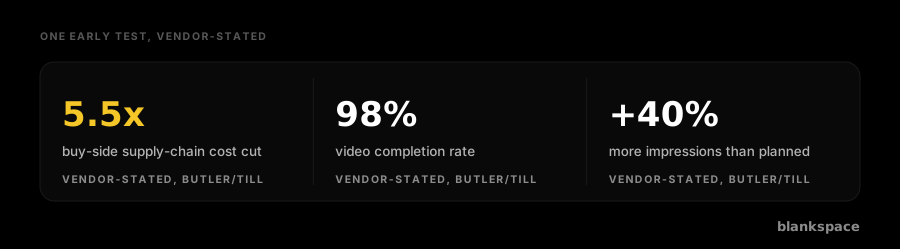
Agentic advertising automates that surrounding layer. Instead of a trader translating a brief into line items, a buyer agent interprets the brief, builds the media plan, sets and adjusts bids against live performance signals, and reallocates spend on its own. In an early PubMatic and Butler/Till test in December 2025, agents interpreted a natural-language brief submitted through Claude, generated the strategy, set up the campaign and optimised it across premium supply. Butler/Till reported the campaign cut buy-side supply-chain costs by 5.5 times, hit a 98% video completion rate and delivered 40% more impressions than planned on the same budget. WPP Media, testing PubMatic's platform, reported campaign setup time cut by 87% in some early runs. Treat these as the vendors' own reported figures from early tests rather than settled market benchmarks, but the direction is clear: the human bottleneck is being removed from the middle of the trade.
What does agentic advertising mean for publishers?
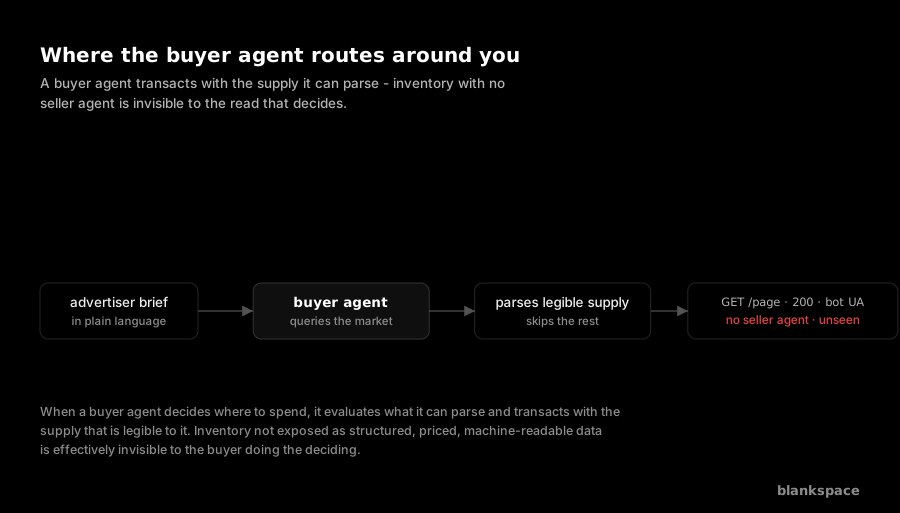
For publishers the shift is structural. When a buyer agent decides where to spend, it does not browse a media kit or take a sales call. It queries the market machine-to-machine, evaluates what it can parse, and transacts with the supply that is legible to it. Inventory that cannot be described in a structured, priced, machine-readable form is effectively invisible to the buyer doing the deciding.
That makes discoverability the new frontier of yield. Publishers who expose their inventory, audience packages and pricing in formats agents can read stand to capture agentic demand; those who wait risk being routed around. Industry reporting is candid that publishers want higher yield and stronger demand from agentic trading rather than mere cost savings, but that sell-side investment is lagging the buy side, held back by technical readiness. Digiday has also documented agencies moving closer to supply as the agentic middle layer reshapes, which raises the stakes for publishers to be represented by their own agent rather than disintermediated by someone else's.
The core risk is representation. Many of the emerging protocols are being designed by and for buyers and the largest platforms. If publishers are not at the table, the standards that govern how inventory is described and valued will encode the buyer's interests by default.
What is a seller agent?
A seller agent is software that represents a publisher's inventory in agentic environments. It translates the publisher's data - what the inventory is, who it reaches, what it is worth and on what terms - into structured formats a machine can process, and it acts as the interface that negotiates and transacts with buyer agents. Where a buyer agent argues the advertiser's case, the seller agent argues the publisher's.
Three moves in 2026 show the seller agent becoming real infrastructure. PubMatic launched AgenticOS on 5 January 2026 at CES, an operating system for agent-to-agent advertising in which advertisers define goals, guardrails and brand-safety rules in an LLM interface and coordinated agents plan, transact and optimise against them; PubMatic launched it with advertisers, agencies and publishers including WPP Media, Butler/Till, Wpromote and MiQ, and reported global acceleration by late April 2026. Magnite introduced Magnite Orchestration on 11 June 2026, a coordination layer that lets buyer agents connect to Magnite's seller agent so publishers can build custom inventory and audience packages with flexible pricing and make them discoverable and purchasable by buyer agents, testing with partners including dentsu and DIRECTV Advertising. And on the open-source side, Prebid's stewardship of a seller agent is a direct attempt to keep publishers structurally represented, giving them a machine-readable way to communicate the value of their inventory rather than depending on protocols written by the buy side.
Which protocols and platforms power agentic advertising?
Agentic trading needs a shared language so that a buyer's agent and a seller's agent can understand each other. The most established is the Ad Context Protocol (AdCP), an open protocol associated with AgenticAdvertising.org that provides a standardised, transparent interface for agent-to-system communication; it underpinned the PubMatic and Butler/Till campaign. Adjacent efforts include the Unified Context Protocol and various agentic real-time-bidding frameworks, each trying to give agents a common way to describe context, inventory and intent.
Platforms then sit on top of these protocols. PubMatic AgenticOS and Magnite Orchestration are the two most visible supply-side operating layers, and the major agencies and demand-side platforms are building buyer agents to plug into them. For a publisher the practical takeaway is that the protocol layer decides whether your inventory is describable and the platform layer decides whether it is reachable. Both need to recognise your supply for an agent to buy it.
What are the risks for publishers?
The first risk is being designed out. Standards built primarily by buyers can under-represent the qualities publishers use to justify premium pricing - context, audience quality, brand adjacency - and reduce inventory to interchangeable reach. A seller agent that can articulate those qualities is the defence.
The second is governance. Autonomy without control creates new failure modes. Reporting cited by eMarketer found 70% of marketers had encountered at least one AI-related incident in their advertising, from hallucinated outputs to off-brand material, and around 40% had to pause or pull ads because of an AI-related problem. Publishers inherit the sell-side version of this: agents transacting inventory at machine speed can misprice, mis-target or mis-describe supply just as fast, so guardrails, logging and human oversight are not optional.
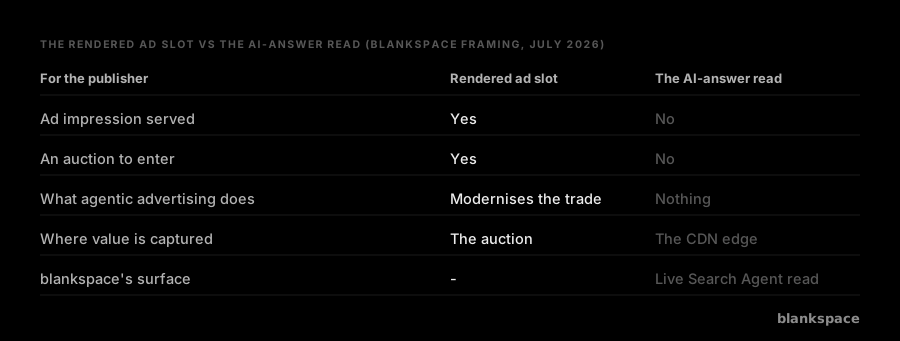
The third is that agentic advertising modernises the trade for the impression that still exists. It makes the buying and selling of a rendered ad slot faster and cheaper, but it does nothing for the growing share of traffic that never renders a slot at all - the AI answer, where a machine reads a page to compose a response and no impression is served. That is a different problem, and it is where the publisher's exposure to the agentic web is largest.
How should publishers prepare?
Start by making inventory legible to machines. Structured, priced, machine-readable descriptions of inventory and audiences are the entry ticket to agentic demand, so the work is to get your supply represented by a seller agent - whether a platform's, such as PubMatic or Magnite, or an open-source one, such as Prebid's - rather than waiting to be found. Set guardrails deliberately: define the goals, floors, brand-safety rules and exclusions that your agent will enforce, because in an agentic trade those settings are your only lever once the machines start dealing. And insist on transparency and logging, so every agent-led decision on your inventory can be audited after the fact.
Then plan for the read that has no slot. blankspace operates on that adjacent surface: the Live Search Agent read at the CDN edge, where an AI system fetches a publisher's content to build an answer and there is no ad auction to enter. Agentic advertising re-tools the auction for the page a human still loads; edge monetisation captures value from the answer a machine composes. The two are complementary rather than competing - one modernises how the existing impression is traded, the other addresses the traffic that never becomes an impression. Publishers preparing for the agentic era are best served treating both as parts of the same shift, because the same buyer agents driving agentic media buying are increasingly the same systems reading pages to answer questions.
Frequently asked questions
Is agentic advertising the same as programmatic advertising?
No. Programmatic automates the auction - the split-second bidding and serving of an ad. Agentic advertising automates the decision-making around the auction: planning, audience design, negotiation, optimisation and reporting, handled by autonomous agents that act on a goal without a human approving each step. Programmatic is the plumbing agentic advertising increasingly runs on, but agentic systems remove the human trader from the middle of the workflow, which programmatic on its own never did.
What is a buyer agent and a seller agent?
A buyer agent is software acting for the advertiser that interprets a brief, plans and buys media, and optimises the campaign. A seller agent is software acting for the publisher that describes, prices and negotiates inventory so buyer agents can find and transact with it. Agent-to-agent advertising is the direct negotiation between the two, completed in fractions of a second, with humans on both sides setting the goals and guardrails rather than clicking through consoles.
How is agentic advertising different from AdCP?
AdCP, the Ad Context Protocol, is one of the standards that lets agents communicate; agentic advertising is the broader practice those standards enable. Think of AdCP as a shared language and agentic advertising as the conversation. A publisher needs the protocol layer, such as AdCP, so its inventory can be described to agents, and it needs a platform, such as PubMatic AgenticOS or Magnite Orchestration, so its inventory can actually be reached and traded. A dedicated protocol page covers AdCP in more depth.
Does agentic advertising help publishers earn from AI answers?
Not directly. Agentic advertising trades rendered ad impressions - display, video and connected TV slots that a buyer agent purchases. It does nothing for the AI-answer read, where a machine fetches a page to compose a response and no ad slot is served. That read is a separate monetisation problem addressed at the CDN edge, where blankspace detects Live Search Agent traffic and injects contextual brand facts into the answer. The two approaches are complementary: one modernises the auction, the other captures value from traffic that never enters an auction.
What should a publisher do first about agentic advertising?
Make your inventory machine-readable and get it represented by a seller agent, whether a platform's or an open-source one such as Prebid's, so buyer agents can discover, evaluate and buy it. Then set your guardrails - floors, brand-safety rules and exclusions - deliberately, because those settings are your main point of control once agents transact at machine speed, and require logging so agent-led decisions on your inventory can be audited. The publishers who expose structured, priced inventory now are the ones agentic demand will find first.