

For two decades, search optimisation meant ranking a page so a person would click it. Answer engine optimisation moves the target: the goal is no longer the click but the answer itself, delivered by the engine before the reader ever chooses a link. AEO is the discipline of formatting and structuring content so that AI Overviews, AI Mode, ChatGPT, Perplexity, Copilot and voice assistants can lift it straight into the response they show the user. In practice that means writing self-contained direct answers, using question-shaped headings, adding structured data, and being the clean, authoritative source an engine can quote without having to interpret. Where classic SEO competed for position on a results page, AEO competes to be the answer on the surface.
What is AEO trying to win?
AEO targets the answer surfaces that increasingly sit above or in place of the traditional link list. That includes Google AI Overviews and AI Mode, People Also Ask boxes, featured snippets, and voice assistant replies, as well as the answers generated by ChatGPT, Perplexity and Copilot. The unifying idea is that the user gets a resolved answer rather than a set of ten blue links, and AEO is the work of making your content the material that answer is built from.
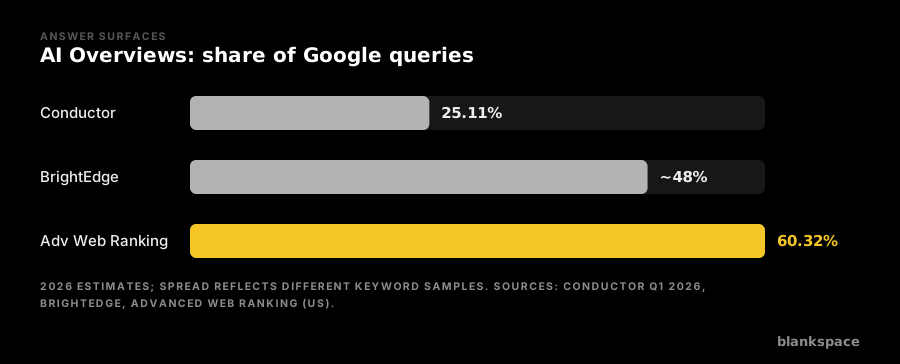
The reason this matters is that answer surfaces now dominate. AI Overviews appear on a large and growing share of Google queries, with estimates in 2026 ranging from around 25 per cent in Conductor's Q1 benchmark to roughly 48 per cent in BrightEdge tracking and above 60 per cent in Advanced Web Ranking's US dataset, the spread reflecting different keyword samples. SparkToro's 2026 analysis put more than 38 per cent of Google searches at zero clicks, and voice accounts for a meaningful slice of search behaviour. When the answer resolves on the surface, the only durable visibility is being the source inside that answer.
How is AEO different from GEO?
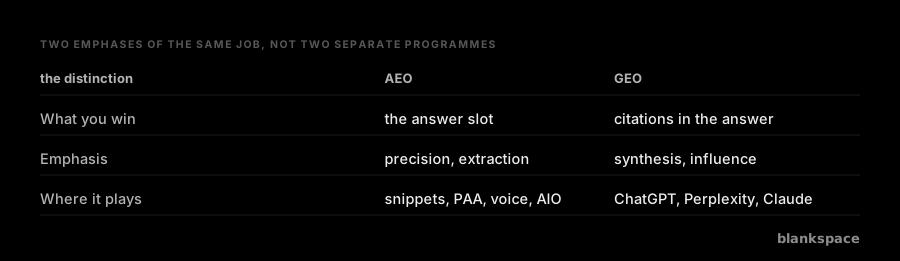
AEO and generative engine optimisation overlap so heavily that some practitioners, including the team at Profound, treat them as the same discipline under different names. The honest position is that they share most of their tactics. The useful distinction, where one exists, is about what you are optimising to win.
AEO leans towards precision and extraction. It aims to give an engine a clean, concise, authoritative answer it can display with confidence, which is why it maps naturally onto featured snippets, People Also Ask, voice replies and the short factual core of an AI Overview. GEO leans towards synthesis and influence. It aims to make content understandable, quotable and reusable by a generative model that composes a new response and decides which sources to cite, which is the game on ChatGPT, Perplexity and Claude. Put simply, AEO is about winning the answer slot, and GEO is about shaping the citations and framing inside a generated answer. Most publishers should treat them as two emphases of the same job rather than two separate programmes.
Where does SEO fit?
SEO has not disappeared; it has become the foundation the other two stand on. Crawlability, clean information architecture, authority and structured data still determine whether an engine can find and trust your content in the first place. AI Overview citations increasingly overlap with organic rankings - BrightEdge found that overlap rising past 54 per cent in 2026 - so strong classic SEO remains one of the better predictors of getting cited. The practical stance for 2026 is that SEO, AEO and GEO are three layers of one strategy, not competing choices.
How do publishers optimise for answer engines?
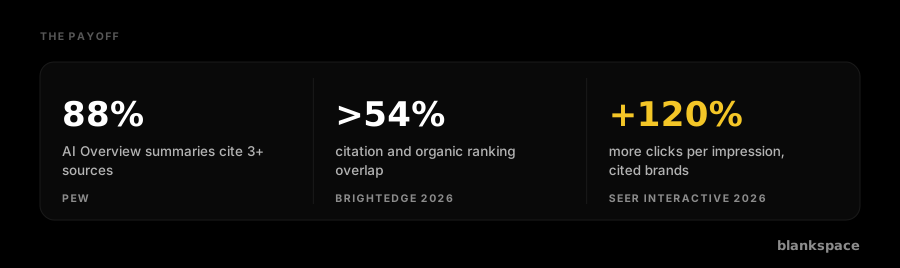
The tactics are familiar to anyone who has structured content for retrieval. Lead each page with a direct, self-contained answer to a named question, before any preamble, so an engine can extract it cleanly. Use question-format headings that mirror how people actually ask. Add FAQ sections and structured data so the machine-readable meaning is explicit. Keep facts specific, current and attributable, because engines favour sources they can trust and quote. Build genuine topical authority rather than thin coverage, since answer engines cite a small set of sources per query - Pew found that 88 per cent of AI Overview summaries cite three or more sources - and you want to be in that set.
The payoff is real visibility rather than raw traffic. Seer Interactive's 2026 analysis found that brands cited in AI Overviews earned around 120 per cent more organic clicks per impression than uncited brands on the same queries. Being the source the answer is built from is now the closest thing to a top ranking.
What AEO cannot do on its own
Here is the limit publishers need to be clear-eyed about. AEO and GEO can win the citation, but a citation is visibility, not revenue. When an answer engine reads your content, synthesises it, and resolves the user's question on its own surface, the reader often never arrives on your page, and the impression the engine served against your work is one you were not paid for and usually cannot even see, because agent and assistant reads rarely register in standard analytics.
That is the gap between being optimised and being monetised. Winning the answer is necessary, but it does not settle the question of how the publisher whose content informed the answer gets compensated. blankspace works at the CDN edge to identify AI agent and assistant traffic as it happens and to place contextual brand facts into the answers those systems generate, which is a way to turn the moment of citation into measurable value rather than uncompensated influence. AEO gets your content into the answer; the harder strategic question is who pays you for being there, and that is worth solving alongside the optimisation, not after it.
Frequently asked questions
Is AEO just a new name for GEO?
Largely, yes, and some practitioners use the terms interchangeably. Both are about being the source AI systems use to answer questions, and they share most tactics. The distinction, where it is drawn, is that AEO emphasises winning the direct answer or snippet slot through precise, extractable content, while GEO emphasises influencing how a generative model synthesises and cites sources. For most publishers they are two emphases of the same discipline rather than separate programmes.
Does AEO replace SEO?
No. AEO builds on SEO rather than replacing it. An answer engine still has to crawl, understand and trust your content before it can quote you, and those are classic SEO problems. In 2026, citation overlap with organic rankings has been rising, which means strong SEO improves your odds of being cited. Treat SEO as the foundation and AEO as the layer that structures content for answer surfaces on top of it.
Which platforms does AEO target?
AEO targets any surface that returns a resolved answer instead of a list of links. That includes Google AI Overviews, AI Mode, featured snippets, People Also Ask and voice assistants, as well as the generated answers in ChatGPT, Perplexity, Copilot and Claude. The common thread is that the user receives an answer directly, so the visibility that matters is being the source inside it.
How do I measure AEO success?
Measurement shifts from rankings and clicks towards citations and share of voice. The core questions are whether your content is being cited in AI Overviews and assistant answers, for which queries, and how often relative to competitors. Traditional analytics undercount this because answer engines and agents often read content without generating a page view, so publishers increasingly need citation tracking and edge-level detection of agent traffic to see the full picture.
Does being cited in an AI answer make money?
Not directly. A citation is visibility, and it can drive some referral clicks, but the engine typically resolves the answer on its own surface and serves the impression itself. The content that informed the answer is not automatically compensated, and much of the reading is invisible to standard analytics. Closing that gap - being paid for the influence, not only optimised into the answer - is a separate problem from AEO, and one publishers should plan for deliberately.