

When a reader reaches a page you have gated, Offerwall swaps the blunt "subscribe or leave" wall for a menu of smaller commitments: watch a short rewarded ad, complete a quick survey, pay a few pence through a micropayment, or take a publisher-defined action such as signing up for a newsletter. Each choice unlocks the content and pays the publisher in a different currency - attention, data, cash or a first-party relationship. Google positions it as a monetisation layer that sits on top of your existing display advertising rather than replacing it, and it is free to switch on inside Google Ad Manager and AdSense. The reason it exists is not subtle: as AI-generated answers absorb the clicks that used to reach publisher sites, the traffic that does still arrive has to be worth more per visit, and Offerwall is Google's attempt to extract more value from each of those remaining visitors.
How does Google Offerwall work?
Offerwall is a message layer, not a new ad product. You build it in the Privacy and Messaging section of Ad Manager or AdSense, choose which pages or sections it gates, and define the set of actions a visitor can take to gain access. When a visitor lands on a gated page, they see a single screen offering those choices instead of the article. Completing any one of them unlocks the content for a defined window.
Google first opened Offerwall for testing in 2024, made it generally available in Ad Manager on 26 June 2025 after a trial spanning more than 1,000 publishers, and extended general availability to AdSense on 13 April 2026. That AdSense rollout matters because it moves Offerwall from the domain of large, Ad-Manager-scale media companies to the long tail of smaller sites that run AdSense, which is where the traffic loss from AI answers often bites hardest.
What can a visitor choose to do?
The default menu covers four broad actions, and publishers can add their own. A rewarded ad asks the visitor to watch a short video or view a display unit in exchange for access, which converts attention directly into ad revenue. A survey asks a few questions and returns both a small payment and useful first-party audience data. A micropayment lets the visitor pay a small sum for temporary access without committing to a full subscription. A custom action lets you gate content behind something you value more than cash today, most commonly a newsletter sign-up or the start of a free trial, turning an anonymous reader into a known, re-contactable one.
The strategic point is that different visitors are worth reaching in different ways. A one-time reader from a social link may never subscribe but will happily watch a rewarded ad; a repeat reader may be worth converting into a newsletter subscriber; a high-intent reader may simply pay. Offerwall lets a single page serve all three without forcing everyone through the same paywall.
How much can Offerwall add to publisher revenue?
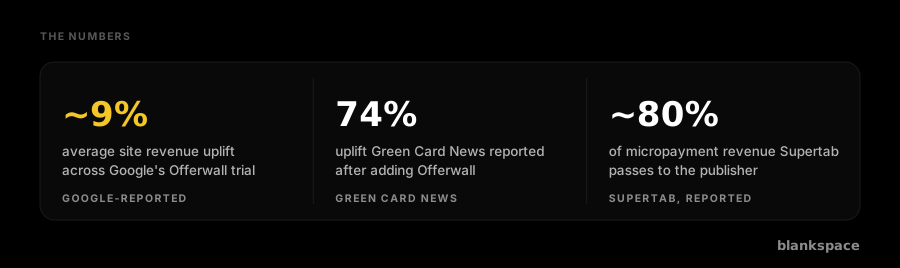
Google's own reported figures from the trial put the average uplift in site revenue at around 9 per cent, with some sites seeing increases of up to 20 per cent. These are Google's numbers from participating trial publishers, not independent benchmarks, so they should be read as indicative rather than guaranteed. Individual case studies run higher: Green Card News, an immigration news site serving readers in Japan, reported a 74 per cent revenue uplift after adding Offerwall while, it said, keeping the reader experience positive.
Google has also reported that switching on the machine-learning timing feature, branded Optimize, produced roughly an 8 per cent improvement in total ad revenue and a 10 per cent improvement in Offerwall conversion rate compared with a manual metering setup. The honest reading is that Offerwall is a genuine incremental lever for many publishers, but the headline percentages are Google-reported and depend heavily on how aggressively a site gates content and how much traffic it still receives. A site that has lost most of its human audience to AI answers is optimising a shrinking base.
What does the AI "Optimize" feature do?
Optimize is the machine-learning layer that decides when and how often to show the Offerwall to each individual visitor, rather than showing it to everyone on a fixed schedule. The aim is to catch a reader at the moment they are most willing to complete an action and to avoid burning goodwill by interrupting someone who was never going to convert. From 10 January 2026, Google began automatically enrolling active Offerwall users into this machine-learning optimisation, so many publishers now run AI-timed Offerwalls by default unless they opt out.
This is worth flagging for two reasons. First, it means the timing decision has quietly moved from the publisher to Google's model. Second, it is an example of the wider pattern in 2026 adtech: the same AI that is eroding referral traffic is now also the engine deciding how to monetise what remains.
How do the micropayments work, and who is Supertab?
The micropayment option is powered by Supertab, a company formerly known as LaterPay. Rather than asking a reader to enter card details for a single article, Supertab lets them add small charges to a running "tab" that follows them across participating sites and is settled later once it reaches a threshold. This removes most of the friction that has historically killed per-article micropayments. Supertab has said it typically passes around 80 per cent of micropayment revenue to the publisher and retains the rest. For publishers, the appeal is a pay-as-you-go tier that captures value from readers who will never buy a full subscription but will spend a few pence to read one thing.
How is Offerwall different from a paywall or a metered wall?
A hard paywall offers one binary choice: subscribe or leave, which converts a small share of readers and loses the rest entirely. A metered wall grants a set number of free articles before that same binary choice appears. Offerwall keeps the gate but widens the set of ways through it, so a reader who will not subscribe can still transact in attention, data or a micropayment. In effect it monetises the "no" that a paywall simply discards. It is best understood as complementary to a subscription strategy rather than a replacement: subscriptions capture your most loyal readers, and Offerwall captures value from the far larger group who will never subscribe but have not left yet.
What Offerwall does not solve: the agent read
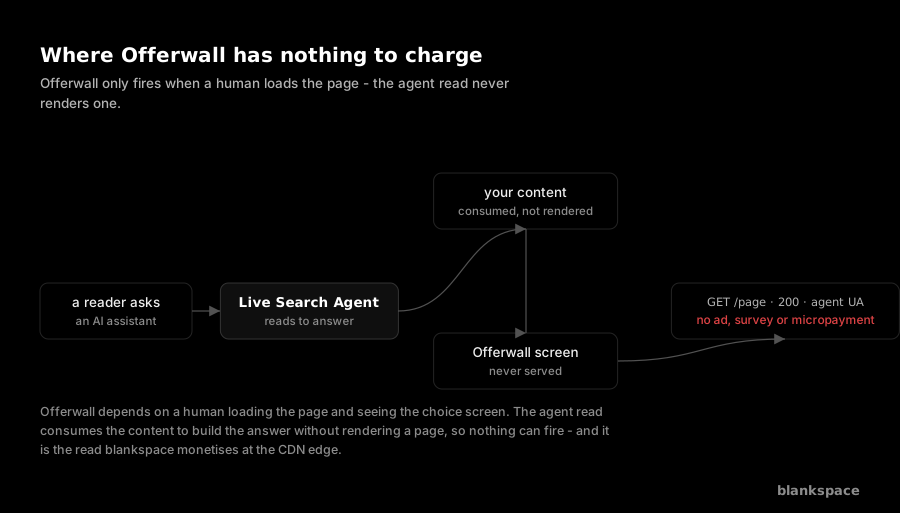
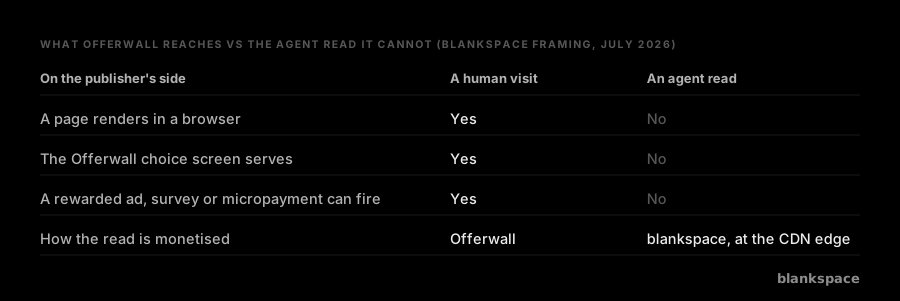
Every mechanism above depends on one condition being met - a human being loads the page in a browser, sees the choice screen, and acts on it. That condition is exactly what the shift to AI answers is removing. When a Live Search Agent or an AI assistant reads your content to compose an answer, no browser renders your page, no Offerwall message is served, and no rewarded ad, survey or micropayment can ever fire. The read still happens, your content still does the work of informing the answer, but there is no human session for Offerwall to monetise. Offerwall is a tool for extracting more from the shrinking pool of human visits; it has no purchase on the growing pool of agent reads that never become visits at all.
This is the gap blankspace is built to close. blankspace operates at the CDN edge, detects agent and Live Search Agent requests as they arrive, and injects contextual brand facts into the AI response itself, monetising the read that never renders a page. The two approaches are complementary rather than competing: Offerwall recovers value from the humans who still land, and edge injection recovers value from the agents that increasingly do not. A publisher planning for the next few years needs an answer to both halves of its audience, because the human half is the one that is shrinking.
Frequently asked questions
Is Google Offerwall free to use?
Yes. Offerwall is available at no cost inside Google Ad Manager and, since April 2026, Google AdSense. There is no separate fee to switch it on; publishers build and configure it through the Privacy and Messaging message builder in their account. Revenue is shared in the normal way for the specific action taken, for example the standard split on a rewarded ad, or Supertab's share on a micropayment.
Does Offerwall replace my display advertising?
No. Offerwall is designed to sit on top of your existing display setup rather than replace it. It targets readers who would otherwise leave at a paywall or contribute little ad revenue, and gives them alternative ways to pay in attention, data or cash. Publishers typically run it alongside their normal ad stack rather than instead of it.
Why did Google launch Offerwall now?
Google launched Offerwall in direct response to the decline in publisher traffic caused by AI-generated search results. With AI summaries cutting referral traffic to many sites by 20 to 60 per cent, and some niche sites reporting losses up to 90 per cent, each remaining visit has to earn more. Offerwall is Google's tool for raising the value of the traffic publishers still receive.
What is the Optimize feature, and am I already using it?
Optimize is Offerwall's machine-learning layer that decides the best moment and frequency to show the message to each visitor. From 10 January 2026, Google began automatically enrolling active Offerwall users into this optimisation, so if you have Offerwall running you are likely using it unless you have opted out. Google has reported it improves total ad revenue and Offerwall conversion rates against a manually configured metering setup.
Can Offerwall monetise AI crawler or Live Search Agent traffic?
No. Offerwall only works when a human loads the page and sees the choice screen, so it cannot monetise the agent and Live Search Agent reads that consume your content to build an AI answer without ever rendering a page. Monetising that traffic requires acting at the CDN edge, where the agent request can be detected and the AI response itself monetised, which is the layer blankspace operates in. Offerwall and edge monetisation address opposite halves of a publisher's audience.