

A publisher today can see one thing: an HTTP request arriving at its servers. Whether that content then entered a model's context, shaped the answer, earned a citation, appeared on the user's screen or prompted a click is entirely invisible. The SPUR Coalition's Content Telemetry standard is a schema that closes that gap, defining a common wire format in which an AI agent reports each of those five moments back to the content owner, at event level and in real time, to an endpoint the publisher nominates. It is a measurement standard rather than a payment mechanism, and it exists so that licensing and compensation frameworks have something reliable to price against.
What is the SPUR Coalition?
SPUR stands for Standards for Publisher Usage Rights. It is a publisher-run coalition formed in early 2026 and publicly launched in March, built to shift AI's use of journalism from opaque scraping towards a transparent, usage-based licensing system publishers control. Founding members include the BBC, the Financial Times, Guardian Media Group, Sky News, Telegraph Media Group, the Belgian group Mediahuis and French publisher CMA Media. The Associated Press joined as the first US founding member on 8 July 2026, alongside roughly 30 publisher members and six affiliates added after an expansion announced at WAN-IFRA's World News Media Congress in Marseille in June. Later joiners include Ringier, and the coalition's first dedicated B2B publishers, Citywire, Times Higher Education and AMLIntelligence.
The AP's arrival matters more than a membership count suggests. The AP is predominantly a licensing business, so it brings hard-won expertise in how news content is valued, licensed and enforced. The coalition is fronted by two co-lead consultants, David Buttle of DJB Strategies, formerly the Financial Times' director of public affairs and platform strategy, and Dominic Young, founder of the payment platform Axate and previously a central figure in the WAN-IFRA-led ACAP project. Alex Springer is technical lead and maintains the standard.
What does the Content Telemetry standard actually measure?
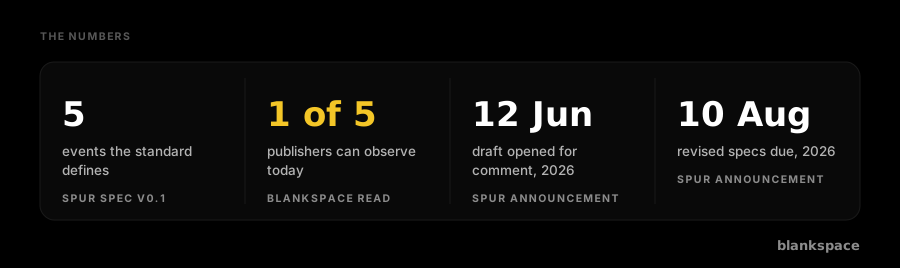
The standard tracks content through five stages, each a progressively narrower subset of the one before.
Retrieved. Content fetched over HTTP. This is the only stage a publisher can already observe.
Grounded. Content loaded into the agent's generation context. This is the event that establishes the content influenced the answer.
Cited. Content explicitly referenced in the response.
Displayed. The user actually saw the reference or the embedded content.
Engaged. The user clicked, expanded, copied, shared, or directed the agent to act.
What ties the five together is a session identifier, one user journey from query to outcome, carried on every event in that journey. The specification also defines the data schema, so what gets sent, when, and about which piece of content is identical across platforms, publishers and vendors. The draft is Apache-2.0 licensed and published on GitHub in two repositories, one for the standard and one for the SPUR profile, with the specification currently at version 0.1 preview.
Why do the gaps between the stages matter?
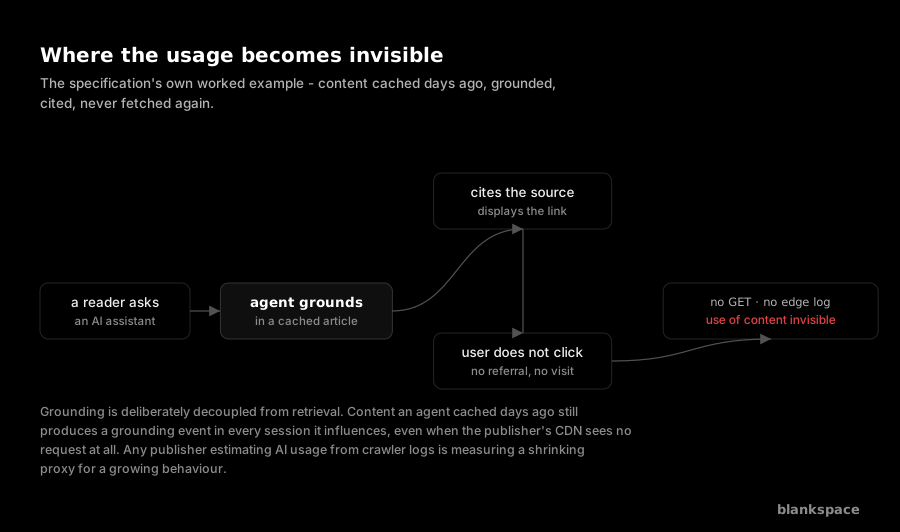
The individual events are less interesting than the distance between them, and this is the part publishers should read closely. The specification names three diagnostic gaps.
Retrieval without grounding means your content was fetched but never used. Grounding without citation means your content shaped the answer and you got no credit for it. Citation without engagement means you were credited and the user did not click. Each of those is a different commercial argument, and none of them can currently be evidenced.
The grounding event is deliberately decoupled from retrieval, which is the single most consequential design decision in the draft. Content an agent cached days ago still produces a grounding event in every session it influences, even when the publisher's CDN sees no request at all. The specification's own worked example makes the point bluntly: an agent grounds a response in a cached FT article, cites it, displays a link and the user does not click. There is no retrieval event, the publisher's edge sees nothing, and the grounding event is the only evidence the content was used. Any publisher currently estimating AI usage from crawler logs is measuring a shrinking proxy for a growing behaviour.
What is the SPUR telemetry profile, and what does "Compliant" mean?
The standard and the profile are separate documents on purpose. The standard defines the wire format and stays neutral, so any community can write its own profile against it. The profile defines what an implementer must do to earn the SPUR conformance mark, and carries the accreditation programme. The dependency runs one way: the profile references the standard by version, and the standard never references the profile.
The profile names a single accreditation tier, Compliant, with four requirements. Conformance to the standard as an emitter at retrieval, grounding or attribution level. Event-level delivery, meaning discrete events per fetch, grounding, citation, display and engagement, with no aggregation. Real-time delivery, with any alternative cadence negotiated publisher by publisher. And routing to a publisher-designated endpoint. Attribution consumers, meaning parties that receive telemetry and redistribute per-publisher views, meet a parallel set including publisher resolution and isolation. Notably, the profile makes no requirement at all about query intent or topic classification, and the standard sets four privacy levels running from full, which shares query and response text, down to minimal, which shares only token counts and content URLs.
How does it relate to Cloudflare pay per crawl, RSL and IAB Tech Lab's CoMP?
Content Telemetry is the reporting side, and it is explicit about that. Access protocols such as peek-then-pay, IAB Tech Lab's Content Monetization Protocols and bilateral licensing APIs govern how an agent discovers and licenses content in the first place. Telemetry describes what happened afterwards. A license_ref field on each event connects the two, and the schemas are deliberately independent, so telemetry works with any access protocol or with none.
That is a cleaner division of labour than the current standards landscape usually manages. Cloudflare pay per crawl and IAB Tech Lab's CoMP work at the pre-crawl ingest stage, deciding whether a bot may take the content and at what price. Really Simple Licensing, backed by publishers including Arena Group, People Inc. and USA Today Co., is a collective licensing framework. SPUR occupies the post-ingest phase that none of them cover, and it is the only one of the four that is publisher-run and focused specifically on editorial IP.
Will the AI companies actually send the data?
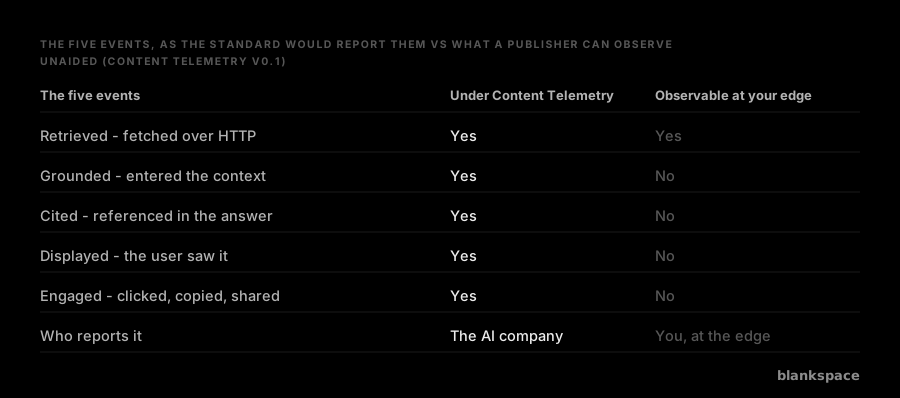
This is the load-bearing question, and nobody involved pretends otherwise. Publishers cannot extract these events themselves. Four of the five stages happen inside systems publishers do not operate, so the numbers are self-reported by the counterparty unless something forces corroboration.
Three things are meant to close that gap. The first is commercial leverage: publishers can require conformance to the standard as a condition of any licensing deal, which is precisely why a broad and international membership is worth more to SPUR than a prestigious one. The second is verification, and SPUR has been openly soliciting input on how publishers should audit self-reported figures, including through what it calls publisher-seeded canary content. The third is corroboration built into the protocol itself, discussed below.
There is also a stick. Some members have been red-teaming their own sites, stress-testing them as if they were scrapers to establish which protections actually hold, with plans to publish the findings. Buttle has been direct about the intent: a number of businesses have built commercial models around infringing IP, and the coalition wants that named as such.
The scepticism is reasonable and worth stating. Publisher alliances have a patchy record, and the previous generation failed to stop programmatic commoditising their inventory. Scott Messer of Messer Media put the condition plainly to Digiday, arguing that the standards and the enforcement around them only work if treated as collective action rather than a series of solo bets. Alessandro De Zanche of ADZ Strategies makes the counter-argument that this round differs because it is built around permission rather than price, and is being run by lawyers, editors and chief executives rather than the ad tech teams who lost the last fight. On the demand side, Microsoft and CDN vendors including Fastly attended a public comment event in London, and TollBit, Redpine and MonetizationOS have told the coalition they intend to implement the five-event standard in their products.
Why the CDN is named in the specification
One design principle deserves more attention than it has had in the trade coverage, because it changes what a publisher's own infrastructure is for.
The standard assumes multiple observers of a single event. A content retrieval can be reported independently by the publisher's CDN, the publisher's origin server and the AI agent, and a Content-Telemetry-ID header correlates those reports into one corroborated event. The corollary is stated outright in the specification: an uncorroborated retrieval, where the publisher's edge logged a fetch and no matching agent event ever arrived, may indicate an agent that does not support the protocol at all.
That turns the publisher's edge from a passive log into an audit instrument. It is the one observation point in the chain that the publisher controls, and under this design it is the mechanism by which a self-reported number becomes a verified one. A publisher that cannot currently identify agent traffic at the edge with confidence has no independent position from which to check anything an AI company sends it. Publishers should also note a small but telling detail in the specification's worked example: the completed turn carries an ad_rendered flag. The standard already anticipates that advertising appears alongside AI answers, and that publishers will want to know when it did.
What should publishers do now?
Read the draft and comment. The specifications are public on GitHub under Apache-2.0, and comments go to the repositories or to the technical lead directly. SPUR's own announcement set the comment window from 12 June to 10 July 2026, and trade coverage in July reported it extended to 24 July, with revised versions of both specifications due by 10 August 2026. The v0.1 open questions are the ones worth attacking: where grounding begins in a multi-stage RAG pipeline that embeds, re-ranks and summarises before context insertion, and how to handle event volume when a single deep-research query can generate more than a hundred retrieval events.
Audit what you can already observe at your own edge, before you need it. Retrieval is the only one of the five events you can corroborate independently, and its value under this standard is precisely that it is yours.
Put conformance language into your next licensing negotiation. The standard has commercial force only where publishers write it into deals, and the terms to ask for are already specified: event-level, real time, to your endpoint.
Decide your privacy level deliberately rather than by default. The four levels determine whether you receive query and response text or only token counts and URLs, and that choice governs how useful the data is to your editorial and commercial teams.
Do not treat telemetry as a revenue line. It is a measurement layer that makes revenue arguments provable. The payment still has to come from somewhere else.
Where this leaves the rest of your AI traffic
Content Telemetry is a genuine advance and publishers should support it. It is also, by construction, a standard that only describes the licensed channel. Telemetry arrives where an AI company has agreed to emit it, which in practice means where there is a relationship, a contract and a commercial reason to comply. For the large majority of publishers who will never sign a licensing deal, and for the long tail of live agent reads that no contract governs, the five events will simply never be sent.
That is the layer blankspace works in. Rather than waiting for a counterparty to report what its agents did, blankspace detects live search agent traffic at the CDN edge as it arrives and injects contextual brand facts into the response, so the retrieval is monetised at the point of the answer whether or not a licence exists. The two approaches solve different halves of the same problem and sit comfortably together: SPUR's telemetry gives a publisher provable usage data inside the licensed channel, and edge detection gives it revenue and independent measurement everywhere else. The argument SPUR is making, that the crawl was never the interesting event and the use of the content is, is the same argument blankspace has been making about monetisation. It holds regardless of which vendor a publisher chooses.
Frequently asked questions
What does SPUR stand for?
SPUR stands for Standards for Publisher Usage Rights. It is a publisher-led coalition launched in early 2026 whose founding members include the BBC, the Financial Times, Guardian Media Group, Sky News, Telegraph Media Group, Mediahuis, CMA Media and, from July 2026, the Associated Press. Its aim is to replace opaque scraping with a transparent, usage-based licensing system, and its first technical deliverable is the Content Telemetry standard.
What are the five Content Telemetry events?
Retrieved, when content is fetched over HTTP. Grounded, when it is loaded into the agent's generation context. Cited, when it is explicitly referenced in the response. Displayed, when the user actually sees that reference. Engaged, when the user clicks, expands, copies or shares. Publishers can observe only the first of the five today, which is the gap the standard exists to close.
Is Content Telemetry the same as Cloudflare pay per crawl?
No. Pay per crawl decides whether a crawler may fetch a page and what it pays to do so, and it operates before ingest. Content Telemetry reports what happened to the content afterwards and moves no money at all. They are complementary layers, and the standard includes a license_ref field specifically so telemetry events can be tied back to whichever access or licensing protocol authorised the fetch.
Do AI companies have to implement the SPUR standard?
No. There is no legal or technical obligation, and this is the standard's central weakness: four of the five events happen inside systems publishers do not control, so the data is self-reported unless corroborated. SPUR's route to adoption is commercial, with publishers requiring conformance as a condition of licensing deals, supported by verification techniques such as publisher-seeded canary content and by cross-checking agent reports against the publisher's own edge logs.
When will the Content Telemetry standard be finished?
The draft standard and the accompanying SPUR telemetry profile were published for public comment on 12 June 2026, with revised versions of both due by 10 August 2026. Both remain preview specifications at version 0.1, and SPUR has said field names, event types and schema structure may change before 1.0, so publishers should treat current implementations as provisional rather than final.